




Vol 7, No 2 (2025)
- Year: 2025
- Published: 24.12.2025
- Articles: 9
- URL: https://bakhtiniada.ru/2658-5480/issue/view/23667
- Description:
Full Issue

Editorial
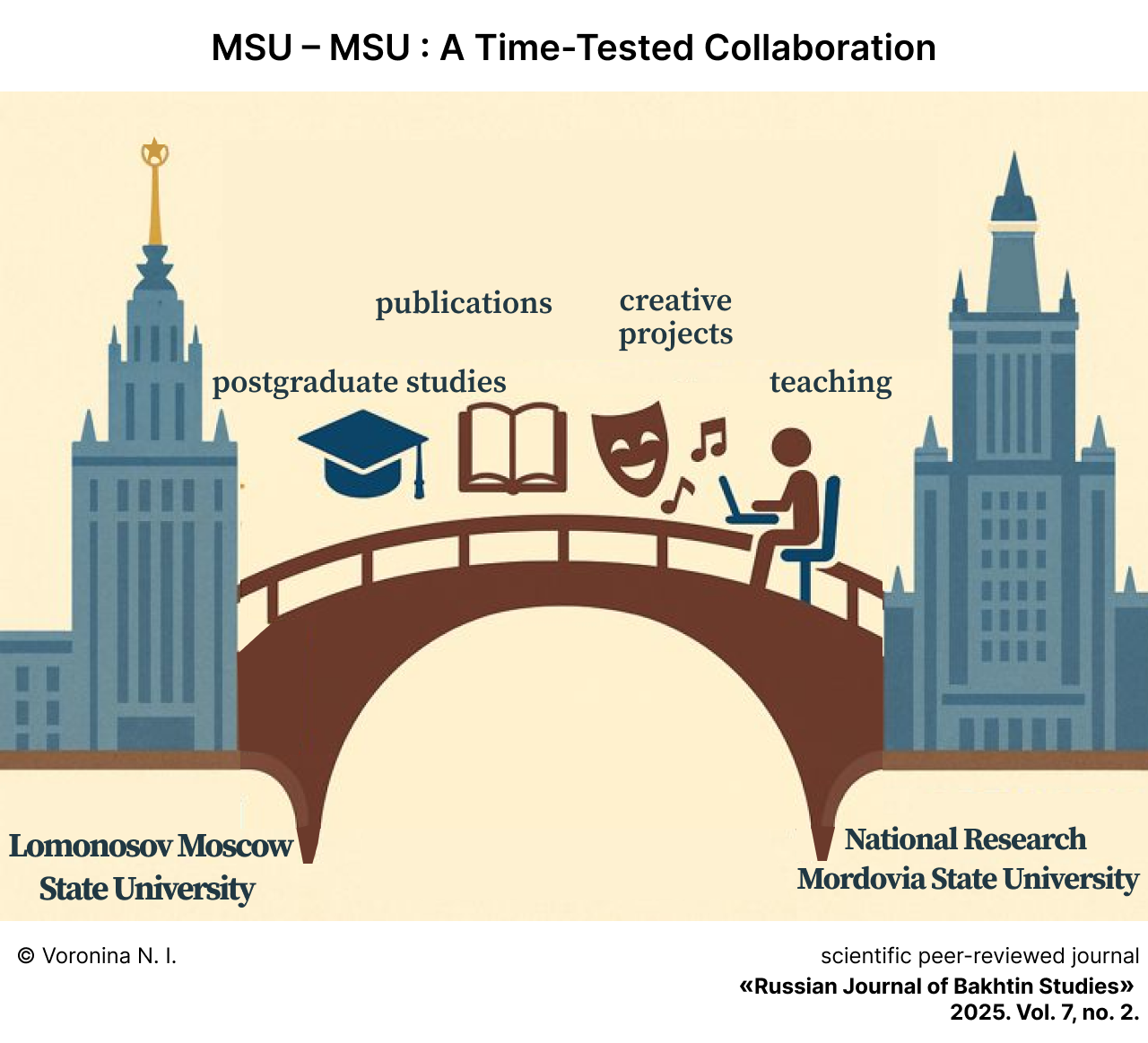
MSU – MSU: A Time-Tested Collaboration
Abstract
The article examines the collaboration between departments of two Russian universities: the Faculty of Arts at Lomonosov Moscow State University and Institute of National Culture at National Research Mordovia State University. The relevance of the study stems from the need for a holistic, systemic study of contemporary university culture and its potential in overcoming the crisis in culture and education. The aim of the study is to demonstrate the dynamics of the relationship between the two universities in the fields of cultural studies and art history, presenting these relationships both in historical perspective and in the context of today’s realities. This is the first study of its kind. The research material represents the experience of collaboration between the Faculty of Arts at Lomonosov Moscow State University and the Institute of National Culture at National Research Mordovia State University in the field of culturology and art history. The main method used in the study is the historical-logical method; the following general scientific methods were used as auxiliary ones: theoretical (analysis, synthesis), empirical (observation, document analysis). The article demonstrates that the collaboration between the two university teams is based on the principle of “cooperation” rather than competition (M. M. Bakhtin). The two teams successfully implement joint scientific and creative projects (research, publications, etc.). Both universities host scientific conferences to discuss the semantic realities of culture and art. Young scholars, graduate students, and undergraduates actively participate in these events. Creative laboratories and practical classes facilitate their acquisition of professional experience. An important aspect of this collaboration is the training of doctors and candidates of science to supplement the pedagogical resources of universities. The study cites specific names of scholars and specialists working at both universities and introducing young people to the world of beauty and knowledge through books, new educational programs, and modern technologies.
 116-126


Theory and History of Culture
M. M. Bakhtin and Scientific Creative Work of G. D. Gachev

Abstract
Introduction. The relevance of this study stems from the need to analyze the continuity of thought in the development of global and Russian humanities. The purpose of this article is to trace the influence of M. M. Bakhtin’s ideas on the works of G. D. Gachev, primarily on his multi-volume series (cycle) of books “National Images of the World”. The author examines G. D. Gachev’s reception of M. M. Bakhtin’s creative legacy, integrating this reception into the general context of intellectual history and the history of ideas.
Materials and Methods. The study’s material includes texts by M. M. Bakhtin and G. D. Gachev, as well as those of foreign philosophers: E. Husserl, P. Ricoeur, W. Dilthey, M. Heidegger and others. The author uses methods of source analysis, systematization, generalization, and comparative analysis.
Results and Discussion. The article emphasizes that M. M. Bakhtin and G. D. Gachev demonstrate an affinity for the synthetic combination of various methods and disciplines, primarily philosophy and philology; both of them partly worked within the framework of hermeneutics. The literary criticism mode in Gachev’s cycle “National Images of the World” is not relegated to the background, but is inscribed in a broader methodological and generally more complex polydiscursive context – primarily cultural-philosophical. M. M. Bakhtin constructs his concepts as an element of cultural philosophy. G. D. Gachev adopts his cultural-philosophical interest in analyzing national images of the world, in composing “humanitarian commentaries” on the natural sciences, etc. In G. D. Gachev, the empiricism of the “I” often prevails over the essence of the “I”. However, such an intensification of mere empiricism of the “I” does not yet signify a victory over the conventions of “fatal theorism” (M. M. Bakhtin’s term). The author concludes that both thinkers (especially G. D. Gachev) largely belong to the realm of heterodox and post-scientific thought.
Conclusion. The article contributes to the comparative study of the work of M. M. Bakhtin and the humanities scholars who were directly influenced by him, as well as his students. It is of interest to scholars studying the methodology of the humanities, as well as to researchers of the creative legacy of M. M. Bakhtin and G. D. Gachev.
127-137
Cultural Imprints of Russian History: From the Symbolism of the Past to the Monumental Codes of the Future

Abstract
Introduction. The study of cultural imprints in Russian history has become particularly relevant in recent decades amid globalization and a crisis of values. Imprints, understood as cultural and symbolic codes that enshrine key events and images in the people’s memory, serve as mechanisms for preserving identity and shaping strategies for the future. Russian culture possesses is a unique heritage; its monumental codes – from Orthodox churches to monuments to military victories – serve as repositories of historical memory and tools for goal-setting. The purpose of this article is to analyze the categories of “imprint”, “impressing” and “cultural code”. to examine the phenomena and processes they designate in the context of Russian history and culture, and to identify their role in the continuity of traditions.
Materials and Methods. The research material is drawn from the works of Russian and international scholars in the theory and history of culture, cultural sociology, semiotics, psychology, philosophy, and evolutionary theory, which utilize the above-mentioned categories. Interdisciplinary approaches are employed: cultural-genetic, typological, semiotic, and phenomenological.
Results and Discussion. It is shown that cultural imprints represent unique mechanisms for capturing experience through historical events (wars, reforms, cultural breakthroughs), religious symbols, and artistic images. Imprinting and impressioning are defined as complementary processes of cultural memory: the former captures culture through critical events, the latter through everyday practices. The cultural code is interpreted as a universal system of signs, filled with imprints. The integration of the categorical apparatus of cultural studies and the sociology of culture allows us to consider imprints as matrices of identity.
Conclusion. Cultural imprints of Russian history are not only elements of the past but also active mechanisms for the cultural future, ensuring identity in the face of global challenges. They correlate with M. M. Bakhtin’s concept of cultural-historical “telepathy”, as well as with F. Tenbruck’s social vocabulary and the concept of cultural trauma developed in contemporary cultural sociology. The research prospects are linked to the development of integrative cultural studies methodologies that will allow us to uncover the evolutionary and prognostic role of imprints and their significance in the strategic goal-setting of culture.
138-148
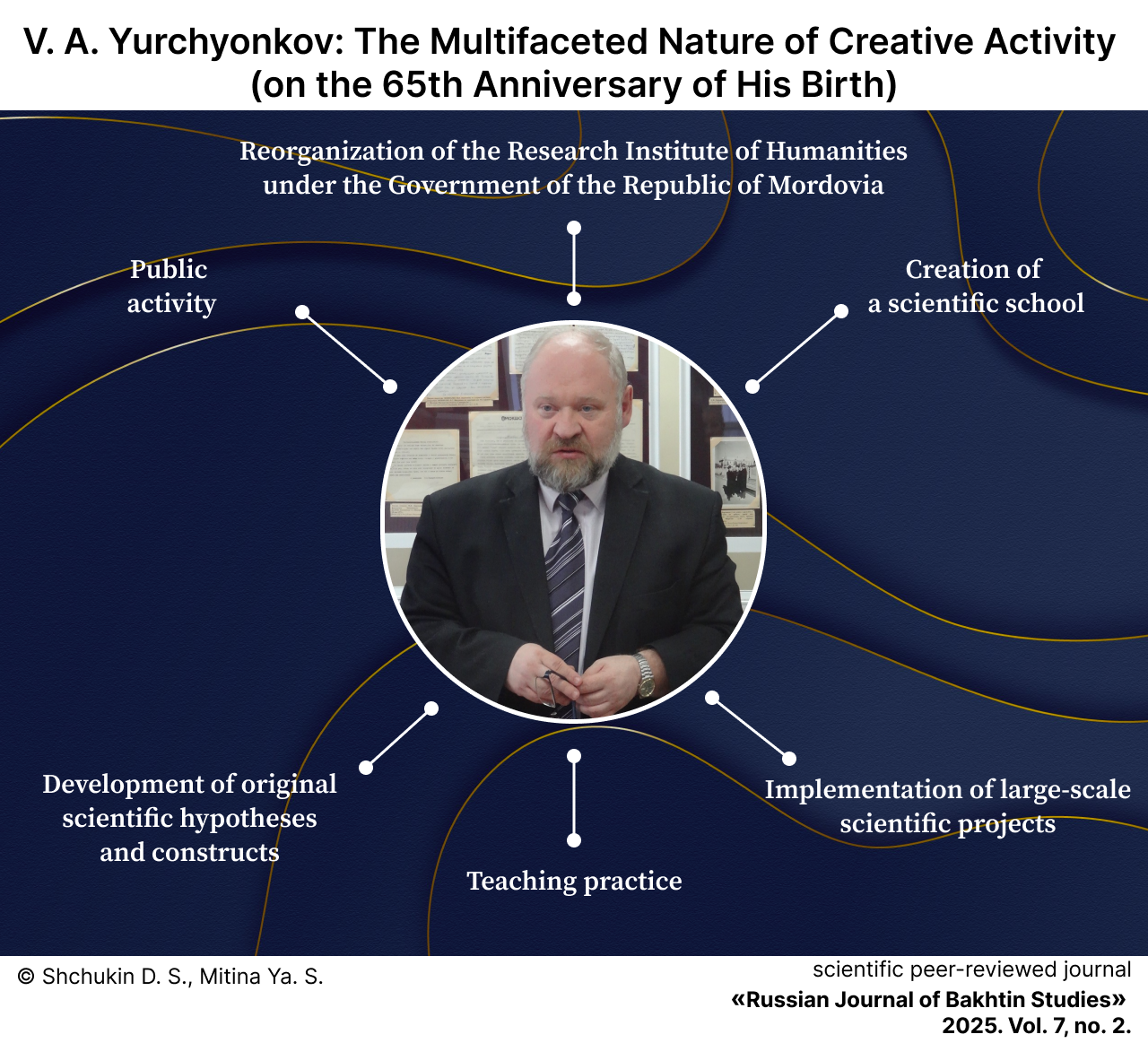
V. A. Yurchyonkov: The Multifaceted Nature of Creative Activity (on the 65th Anniversary of His Birth)
Abstract
Introduction. The relevance of this study stems from the need to understand the contribution of Doctor of Historical Sciences, Professor V. A. Yurchyonkov to the development of regional historical scholarship and humanities research in the Republic of Mordovia. The aim of this article is to comprehensively analyze the scholar’s scientific, organizational, and pedagogical legacy.
Materials and Methods. The study draws on the scholarly works, projects, and organizational initiatives of V. A. Yurchyonkov, as well as the work of his colleagues and followers. The article’s methodological basis are the principles of systematicity and scientific objectivity. The authors utilize historical-biographical and historical-genetic research methods.
Results and Discussion. This article examines key areas of V. A. Yurchyonkov’s work: the reorganization of the Research Institute of Humanities under the Government of the Republic of Mordovia, the creation of an academic school, the implementation of large-scale research projects, the development of his own scientific hypotheses and constructs, public activities, and teaching practice. It shows that V. A. Yurchyonkov, distinguished by his unique scholarly erudition and professionalism, was a broad-based scholar in the humanities and a conceptualist who defined the essence of the development of Mordovia regional history as an integral part of a single all-Russian historical process. The scholar defines the configuration of the historical development of the Mordovian people and the Mordovia region within the framework of his concept of the formation of the Mordovians as a “pulsating” ethnic group, as well as in the context of the multidirectional and varying in strength, yet stable, interaction between the Russian center and periphery. V. A. Yurchyonkov is known as an educator and organizer of science. The academic school he founded includes many researchers successfully working at the intersection of history, cultural studies, ethnology, ethnosociology, historiosophy, and other disciplines. He is also the author of fiction and the screenwriter of short historical documentary films. The scholar was a true patriot of his native land and a consistent promoter of Mordovia history and culture. V. A. Yurchyonkov’s creative public stance and his work aimed at preserving the memory of military and historical events, developing memorial practices, and promoting the cultural achievements of Mordovia continue to resonate deeply with his colleagues in the republic. He has received well-deserved recognition at the Russian and international levels.
Conclusion. The authors emphasize that V. A. Yurchyonkov’s legacy represents a holistic system combining fundamental research, organizational development, and teaching practice. His work laid the foundation for the further development of humanities in Mordovia and became a model for the integration of regional history into national academic discourse. This article contributes to understanding the role of new ideas and methodological approaches introduced by V. A. Yurchyonkov to modern scholarship. Its materials can be used in research in the fields of regional studies and local history, and in teaching the humanities.
149-158
Theory and History of Art
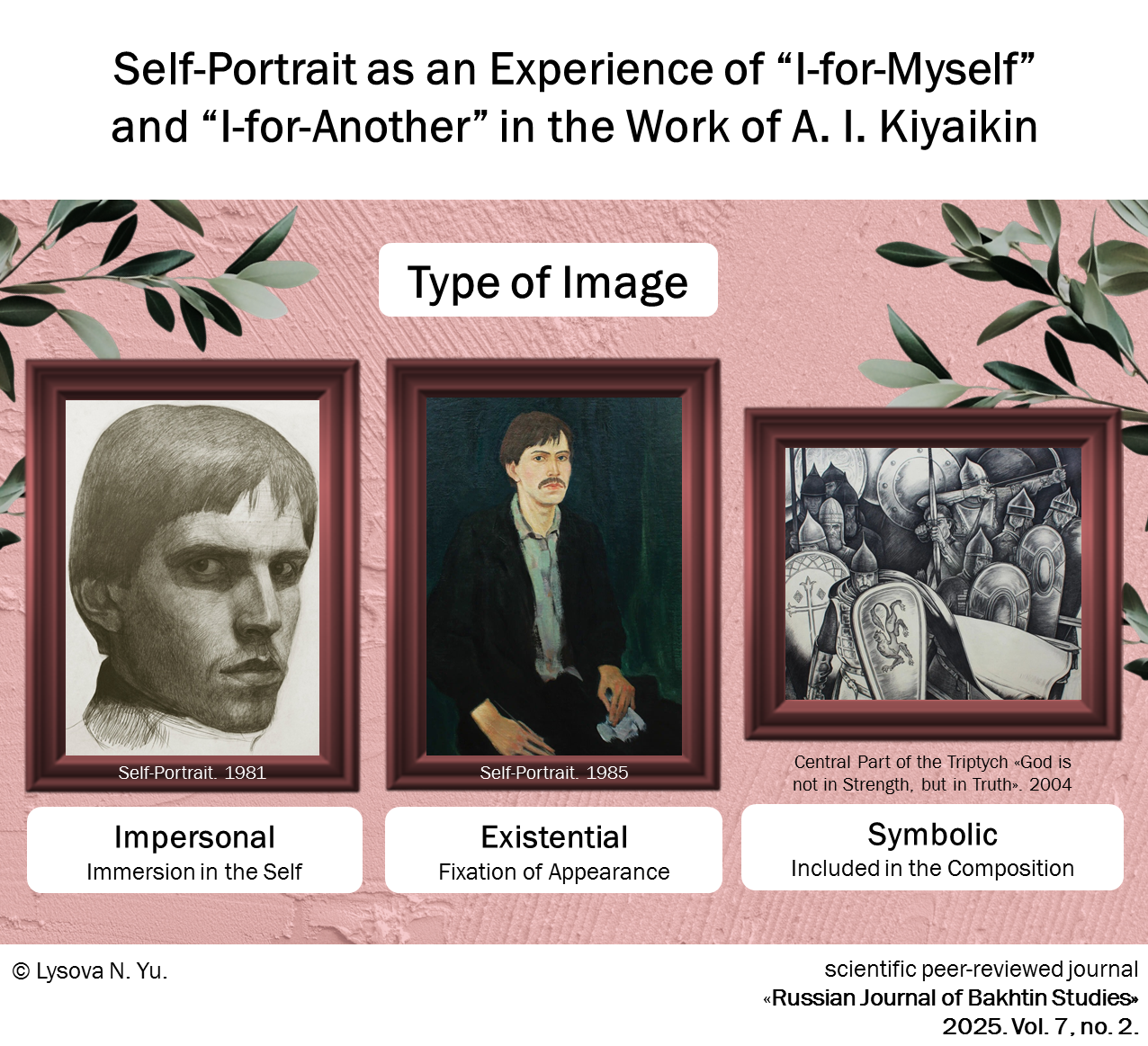
Self-Portrait as an Experience of “I-for-Myself” and “I-for-Another” in the Work of A. I. Kiyaikin
Abstract
Introduction. The relevance of the study stems from the need to understand the contemporary artistic process in Russia and in Mordovia. The article examines the work of A. I. Kiyaikin, a Saransk painter and graphic artist who passed away prematurely. It examines for the first time a series of his graphic and painted self-portraits, which became known only after his death. The author arranges these works in a chronological and substantive sequence, clearly demonstrating the development of the artist’s creative personality and position. The objective of this study is to introduce Kiyaikin’s series of self-portraits into scholarly circulation, situating them within the general context of Russian art from the late 20th to the first quarter of the 21st century, and identifying typical and individual traits in the development of the personality of a contemporary Russian artist.
Materials and Methods. The study focuses on Kiyaikin’s graphic and painted self-portraits. Art history (formal and iconographic) and cultural studies (cultural hermeneutics) methods are employed. The study is embedded within the framework of M. M. Bakhtin’s conceptual understanding of the self-portrait phenomenon, ranging from “self-for-myself” to “self-for-others”.
Results and Discussion. The self-portrait (the artist’s self-created image) is one of the most complex and profound genres in the visual arts. Immersion in its space (that of the artist themselves and the viewer perceiving the work) depends on many factors related to understanding or deciphering the meanings expressed by the artist. Artists turn to the self-portrait genre to define their place in culture. At different stages of their lives, they see themselves differently, and a changing world alters their worldview. The artist immerses themselves in their inner experiences, reflecting on their purpose and the nature of their creativity, attempting to find the optimal balance between subjectivity and objectivity. Self-portraits do not occupy a central place in A. I. Kiyaikin’s work; however, they help us understand the artist, his inner creative principles and positions, and discover the unique structure of his art. While analyzing A. I. Kiyaikin’s self-portraits, the author concludes that they fit logically into a comprehensive series of self-images by artists from different periods in the development of Russian art.
Conclusion. This article introduces a significant series of previously unknown graphic and pictorial self-portraits by A. I. Kiyaikin to scholarly circulation. These works not only represent important facts about his creative biography but also reveal his civic positions and help us better understand his creative and human potential. This article contributes to the study of contemporary fine art in Mordovia and Russia as a whole, and to the exploration of self-portraiture as a genre of fine art. It may be useful to art historians and cultural scholars, in examining the work of A. I. Kiyaikin and in understanding the current stage of Russian artistic development.
159-175
The Alto School of M. N. Terian at the Moscow Conservatory: Trends in the Development of Creative Potential
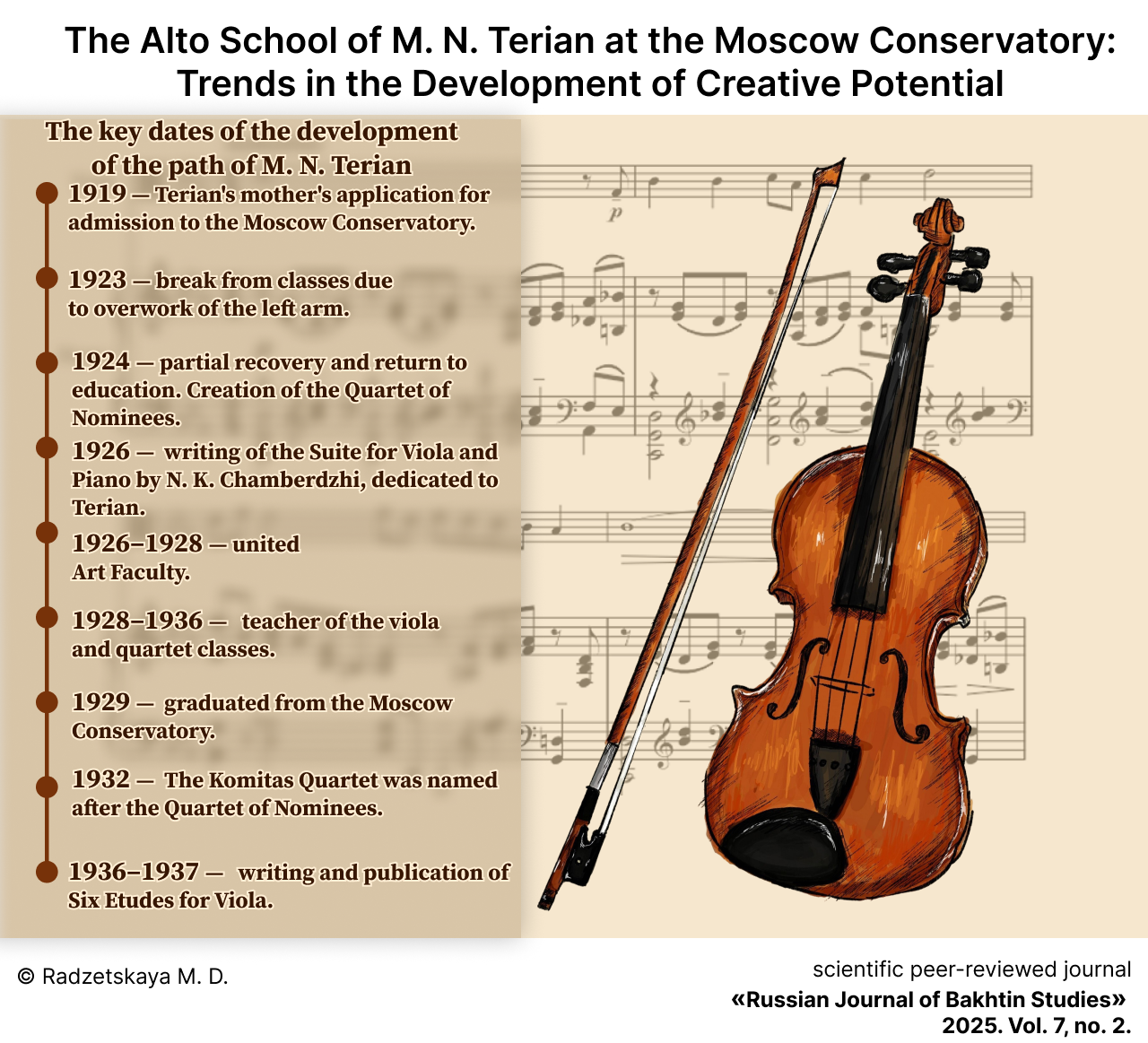
Abstract
Introduction. The Viola School of the Moscow State Tchaikovsky Conservatory, founded by V. V. Borisovsky, is a remarkable phenomenon in the history of Russian musical art, and is of undoubted scholarly interest. The 1920s and 1930s were a period of active development for the viola school, marked by an expansion of the faculty, growth in professional skill, and the development of its distinctive style. During these years, the artistic individuality of many of its performers and teachers was formed. The purpose of the article is to uncover unknown facts about the biography and creative work of one of the outstanding representatives of the viola school, M. N. Terian (1905–1987), and to characterize his contribution to its development.
Materials and Methods. The research material is based on documents from the Moscow Conservatory archives related to M. N. Terian: fragments of his personal file, musical manuscripts recording his own compositional experiments and works by other composers dedicated to him (N. K. Chemberdzhi). All sources are being introduced into scholarly circulation for the first time. The study is conducted within the framework of musical culturology. The author utilizes a historical and biographical method, as well as musical textual criticism and source study.
Results and Discussion. The historical and cultural boundaries of viola performance in Russian musical art are defined, along with genre and repertoire features of compositional and performance creativity, the pedagogical process, and mastery. The professional characteristics of the viola school at the Moscow Conservatory are established. The characteristic features associated with the objective and subjective profile of its development and the cultural context of the era are analyzed. The features of the pre-war educational process and new benchmarks shaping the understanding of the creative evolution and development of the viola repertoire are reconstructed.
Conclusion. Referring to the work of M. N. Terian as a comrade and like-minded collaborator of V. V. Borisovsky is extremely important in the development of a contemporary musician who embraces the instrument (the viola) in a broad and multifaceted manner – in its inexhaustible spiritual and sonic diversity and conceptual interpretation. The materials introduced into scholarly circulation in this article provide a valuable resource for addressing current theoretical and practical issues related to the art of viola performance. They may also be of importance to musicologists researching the history of the Moscow Conservatory and the history of Russian musical art in general.
176-194
Biographical and Archival Research
The Sitnikovs – Relatives of M. M. Bakhtin: Unknown Pages in the Family History
Abstract
Introduction. The relevance of the study stems from the need to create an objective and reliable scholarly biography of M. M. Bakhtin, which requires including information about his family. The purpose of the article is to present previously unknown facts about the Bakhtin family and their relatives the Sitnikovs, and to identify the individuals who made up their immediate circle.
Materials and Methods. The study material consists of unpublished sources from Russian archives, both state (State Archives of the Russian Federation, Manuscript Department of the Russian State Library) and personal (L. S. Melikhova’s archive), printed reference sources, and published transcripts of conversations between M. M. Bakhtin and V. D. Duvakin. The study was carried out within the framework of “historical personology” using historical-biographical, comparative-contrastive and hermeneutic methods.
Results and Discussion. The article examines the connections between two related families representing the Oryol merchant class – the Bakhtins and the Sitnikovs – and identifies the figures who made up their “inner circle” (honorary citizens of Oryol the Avilovs, nobles the Tsurikovs, and others). It reveals unknown facts in the biography of M. M. Bakhtin’s halfuncle T.A. Sitnikov, who occupied a prominent position in the Oryol municipal government before the 1917 Revolution and presents for the first time information about his brother, P. A. Sitnikov. It traces the life story of M. M. Bakhtin’s sister E. T. Sitnikova (a first cousin on his mother’s side and a second cousin on his father’s side), who remained a faithful custodian of the memory of her departed relatives until the end of her days. It presents excerpts from her letters to M. M. Bakhtin, dated 1969–1974. It reveals the reasons that prompted her will to destroy all the documents and materials on the history of the two families which she carefully had preserved. The authors conclude that, despite all the tragic cataclysms that the Sitnikovs experienced after the 1917 Revolution, members of the family strove to maintain ties with surviving close and distant relatives and honor the memory of those who had passed away.
Conclusion. The article contributes to research into the family history of the Bakhtins and the Sitnikovs, and deepens our understanding of their circle. Previously unknown archival materials, first introduced into scholarly circulation, significantly expand the source base for Bakhtin studies. The materials presented in the article may be useful to Bakhtin scholars, as well as researchers of the history of the city of Oryol and the Oryol merchant class.
195-217
Chronicle
 218-229
 230-233