Search

Issue
Title
Authors
Modern Spanish Joke "Chiste" in Terms of Genre
Tarasenkova Y.V.
Mikhail Lermontov’s “The Demon”: Reverse Translation as a Source of Intertextuality
Chesnokova O.S., Talavera-Ibarra P.L.
Approaches to Genre Analysis of English Engineering Discourse
Bolsunovskaya L.M.
“The Twenty Percent Solution”: The Concept of Social Capital through the New Words in English Business Discourse at the Turn of the 21st Century
Galchuk L.M.
Mediatization of Culture in the Discourse of Modern Kazakh Media
Baigozhina D.O., Klushina N.I., Takhan S.S.
Celebrity gossip as a genre in English-language mass media discourse
Ivanova S.V., Khakimova G.S.
Linguistic creativity and discourse profiles of English language children’s novels
Kiose M.I.
Markers of emotionality in Russian news coverage of the 75-th anniversary of WWII Victory
Dobrosklonskaya T.G.
A semiotic portrait of a big Chinese city
Leontovich O.A., Kotelnikova N.N.
Big oil and climate change: An ecolinguistic perspective
Alexander R.J., Ponton D.M.
The evolution of pragmatic marker zenzen in Japanese: From objectivity to intersubjectivity
Park J.
Glocalized voices in Assault Police : A model of communing affiliation and affective positioning
El Shazly R.
Metaphors across languages, cultures and discourses: A research agenda
Zibin A., Solopova O.A.
Metaphorical image of the BRICS in South African media discourse: A corpus-based study
Solopova O.A., Koshkarova N.N.
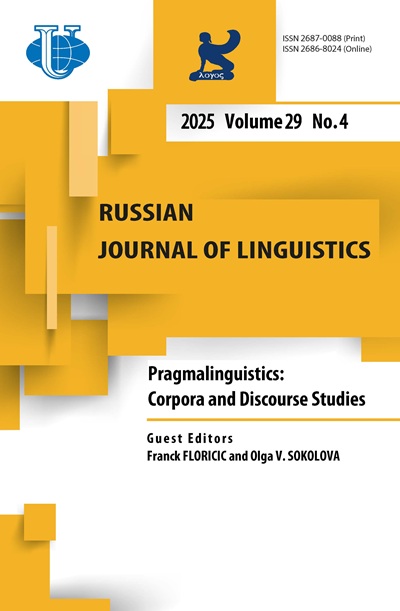
Pragmalinguistics: Сorpora and discourse studies
Floricic F., Sokolova O.V.
PERSUASION IN POLITICAL DISCOURSE: BARAK OBAMA’S PRESIDENTIAL SPEECHES AGAINST ISIS
ALEMI M., LATIFI A., NEMATZADEH A.
News media depictions of people with mental disabilities in Indonesia: A corpus-assisted discourse study
Al Fajri M.S., Isti’anah A.
English borrowings in the French financial discourse as a feature of national character
Naydenova N.S.
Determining parameters of Speech Etiquette Units
Nikashina N.V., Batalov A.A.
Irony in Political Discourse: Aggression or Entertainment?
Gornostaeva A.A.
Pragmatics of Emotions in Modern French Advertising
Borisova A.S., Rubinshtein K.E.
Destructiveness in Political Discourse
Volkova Y.A., Panchenko N.N.
Features of Realization of Figurativeness in the Turkish Political Discourse of Oral Public Statements
Shtanov A.V., Belykh E.N.
Shopping as ‘Best Practice’ - Analyzing Walmart’s Debated Sustainability Policies
Abbamonte L., Cavaliere F.
RHIZOME AND DISCOURSE OF INTERMEDIALITY
Sinelnikova L.N.
Multimodal IT marketing discourse: An integrated approach investigation
Sokolova N.V.
Emergent impoliteness and persuasive emotionality in Polish media discourses
Lewandowska-Tomaszczyk B., Pęzik P.
Functional categories of hedges: A diachronic study of Russian research article abstracts
Boginskaya O.A.
Cognitive complexity measures for educational texts: Empirical validation of linguistic parameters
Kupriyanov R.V., Bukach O.V., Aleksandrova O.I.
From truth to truly: The case of shinni ‘truly’ in Japanese compared to Chinese, Korean and Thai counterparts
Higashiizumi Y., Shibasaki R., Takahashi K.
Compound nouns as linguistic framing devices in Arabic news headlines in the context of the Israel-Gaza conflict
Zibin A., Altakhaineh A.R., Jarrah M.
Structure and dynamics of communicative interaction between a potential patient and a doctor during written medical Internet consultation
Komalova L.R.
Generic uses of the English pronoun one and the Spanish pronoun uno in parliamentary debates
Vilinbakhova E.L., Chuikova O.Y.
Modern Linguistics through Post-Secular Perspective
Naydenova N.S.
Analysis of Lexical Features of the Russian and English Languages in the Sphere of Information Technologies
Kameneva N.A.
A functional-pragmatic approach to wealth-related euphemisms study in business discourse
Malyuga E.N., Tomalin B.
Metaphorical representation of Russia in the political discourse of anglophone mass media
Shapieva D.Z.
Emotive Character of a Diplomatic Discourse
Belyakov M.V.
Precedent Phenomena in Quebecois Linguistic World View
Bolotina K.E.
Discourse Motivations of Mental Construal and the Expression of Stance in Speech: A Case Study of English
Khrisonopulo E.Y.
THE EXPRESSION OF POLITENESS IN A BILINGUAL SETTING: EXPLORING THE CASE OF MALTESE ENGLISH
Cremona M., Assimakopoulos S., Vella A.
Conceptual Metaphor as a Means of Terrorist Suggestion (on the Material of the Islamic State Video Messages)
Fomin A.G., Mona E.A.
Political Discourse, Code-Switching, and Ideology
Moody S., Eslami Z.R.
Inter-annotator agreement in spoken language annotation: Applying uα-family coefficients to discourse segmentation
Pons Bordería S., Pascual Aliaga E.
The UK as victim and hero in the Sun’s coverage of the Brexit ‘humiliation’
Zappettini F.
An explanatory combinatorial dictionary of English conflict lexis: A case study of modern political discourse
Solopova O.A., Khomutova T.N.
The image of Russia through animal metaphors: A diachronic case study of American media discourse
Solopova O.A., Nilsen D., Nilsen A.
The way of truth: The case of the Korean discourse marker cincca in comparison with Chinese zhenshi and zhende
Rhee S., Zhang L.
Euphemisms in South African English economic discourse: Socio-cultural aspects
Malyuga E.N., Tomalin B.
Modern forms of a prophecy: From written word to audiovisual Internet product
Fomin A.G., Karacheva N.S.
The Ethnocultural Potential of Voice Forms and Its Discourse Actualization
Kozlova L.A.
Imitation, Informational Value and Phatic Communication in the Genres of Academic Discourse
Brusenskaya L.A., Kulikova E.G.
The linguistic means of persuasive communication in the election campaign discourse
Baghana J., Bocharova E.A.
Spanish media discourse: Convergent and divergent processes
Gribanov I.S., Mamontov A.S.
Criteria of newsworthiness in televisual media discourse of modern Spanish language
Gribanov I.S.
Politeness Strategies Employed By Americans and Russians When Declining an Invitation
Schelchkova E.B.
Movements and Meanings: Towards an Integrated Approach to Political Discourse Analysis
Ponton D.M.
Narratives about Displacement and Stigmatization of Identities
de Oliveira M.C., Lisboa C.M.
Metapragmatics of Administering Justice in Russian and English Judicial Discourse
Dubrovskaya T.V.
Towards a Semantic Analysis of Russian Discourse Markers: pozhaluj, nikak, vsjo-taki
Zalizniak A.A., Paducheva E.V.
What makes a text interesting? Interest-evoking strategies in expository text from Russian school textbooks
Piotrovskaya L.A., Trushchelev P.N.
Language, culture and ideology in discursive practices
Bilá M., Ivanova S.V.
Emotions and attitudes in present day Russian through the prism of new words: Cultural semantics of zhest’ and related concepts
Gladkova A.
Towards a Multimodal Hermeneutic Model: The case of Uber-Blog-mediated advertising discourse order of ‘Saudization’
Salama A.H.
Phraseological patterns supporting effective academic writing rhetoric: The case of pedagogy research paper introductions
Vaňková I.
Speaker-orientation meaning and positional shifts of discourse structuring markers
Long H., Wang L.
The pragmatics of denial and resistance: Some theoretical and methodological considerations
Abdel-Raheem A.
ENGLISH AND RUSSIAN TERMS “NATIVE SPEAKER”: ILLUSORY EQUIVALENTS
LOVTSEVICH G.N., GICH O.N.
The Realization of Impoliteness in Arguments between the Democrats and Republicans over the Government Shutdown Issue in the US
Alemi M., Latifi A.
Paradigm and discourse metaphors: a cognitive approach to metaphor in science
Koulchitskaya L.V.
Irony in English and Russian discourses: comparative analysis
Gornostaeva A.A.
101 - 171 of 171 Items << < 1 2 

Search tips:

  • Search terms are case-insensitive
  • Common words are ignored
  • By default only articles containing all terms in the query are returned (i.e., AND is implied)
  • Combine multiple words with OR to find articles containing either term; e.g., education OR research
  • Use parentheses to create more complex queries; e.g., archive ((journal OR conference) NOT theses)
  • Search for an exact phrase by putting it in quotes; e.g., "open access publishing"
  • Exclude a word by prefixing it with - or NOT; e.g. online -politics or online NOT politics
  • Use * in a term as a wildcard to match any sequence of characters; e.g., soci* morality would match documents containing "sociological" or "societal"

Согласие на обработку персональных данных с помощью сервиса «Яндекс.Метрика»

1. Я (далее – «Пользователь» или «Субъект персональных данных»), осуществляя использование сайта https://journals.rcsi.science/ (далее – «Сайт»), подтверждая свою полную дееспособность даю согласие на обработку персональных данных с использованием средств автоматизации Оператору - федеральному государственному бюджетному учреждению «Российский центр научной информации» (РЦНИ), далее – «Оператор», расположенному по адресу: 119991, г. Москва, Ленинский просп., д.32А, со следующими условиями.

2. Категории обрабатываемых данных: файлы «cookies» (куки-файлы). Файлы «cookie» – это небольшой текстовый файл, который веб-сервер может хранить в браузере Пользователя. Данные файлы веб-сервер загружает на устройство Пользователя при посещении им Сайта. При каждом следующем посещении Пользователем Сайта «cookie» файлы отправляются на Сайт Оператора. Данные файлы позволяют Сайту распознавать устройство Пользователя. Содержимое такого файла может как относиться, так и не относиться к персональным данным, в зависимости от того, содержит ли такой файл персональные данные или содержит обезличенные технические данные.

3. Цель обработки персональных данных: анализ пользовательской активности с помощью сервиса «Яндекс.Метрика».

4. Категории субъектов персональных данных: все Пользователи Сайта, которые дали согласие на обработку файлов «cookie».

5. Способы обработки: сбор, запись, систематизация, накопление, хранение, уточнение (обновление, изменение), извлечение, использование, передача (доступ, предоставление), блокирование, удаление, уничтожение персональных данных.

6. Срок обработки и хранения: до получения от Субъекта персональных данных требования о прекращении обработки/отзыва согласия.

7. Способ отзыва: заявление об отзыве в письменном виде путём его направления на адрес электронной почты Оператора: info@rcsi.science или путем письменного обращения по юридическому адресу: 119991, г. Москва, Ленинский просп., д.32А

8. Субъект персональных данных вправе запретить своему оборудованию прием этих данных или ограничить прием этих данных. При отказе от получения таких данных или при ограничении приема данных некоторые функции Сайта могут работать некорректно. Субъект персональных данных обязуется сам настроить свое оборудование таким способом, чтобы оно обеспечивало адекватный его желаниям режим работы и уровень защиты данных файлов «cookie», Оператор не предоставляет технологических и правовых консультаций на темы подобного характера.

9. Порядок уничтожения персональных данных при достижении цели их обработки или при наступлении иных законных оснований определяется Оператором в соответствии с законодательством Российской Федерации.

10. Я согласен/согласна квалифицировать в качестве своей простой электронной подписи под настоящим Согласием и под Политикой обработки персональных данных выполнение мною следующего действия на сайте: https://journals.rcsi.science/ нажатие мною на интерфейсе с текстом: «Сайт использует сервис «Яндекс.Метрика» (который использует файлы «cookie») на элемент с текстом «Принять и продолжить».