



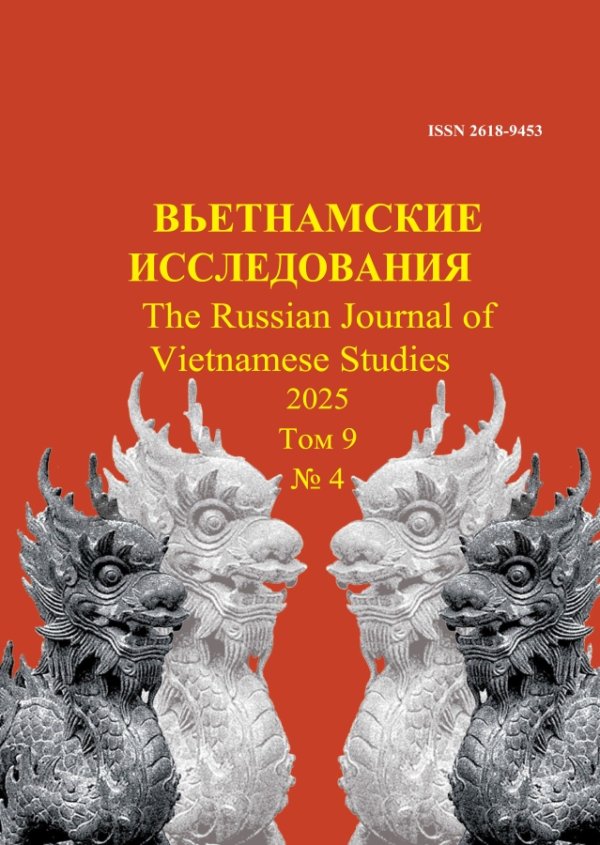
The Russian Journal of Vietnamese Studies
The quarterly peer-review academic journal.
Editor-in-Chief
- Doctor of Economics, Professor Vladimir M. Mazyrin
ORCID: 0000-0001-6988-0139
Founder
- Center for Vietnam and ASEAN Studies of the Institute of Far Eastern Studies of the Russian Academy of Sciences.
About
The journal publishes original papers on various fields of Vietnamese studies: politics, economics, society, history, culture, philology, as well as reviews of scientific conferences dedicated to Vietnam, information on the defense of dissertations in Vietnamese studies, the most important official documents, book reviews about Vietnam and articles on leading Russian and Vietnamese scientists in this field.
The audience of the journal is scientists and academicians working in the area of Vietnamese studies, teachers and university students, as well as anyone interested in Vietnam.
Mission of the journal: integrate the results of scientific work of Russian and foreign scientists in various fields of Vietnamese studies into the international scientific space, be an international platform for scientific discussion, acquaint scientists and everyone interested in Vietnam with the latest research, scientific events and the latest literature about Vietnam.
Main research fields:
- Historical sciences and archeology
- Economic Sciences
- Philological sciences (Literary criticism; Linguistics)
- Sociological sciences
- Political science
- Culturology
Publications
- Quarterly
- Bilingual (accepts and publishes full-text manuscripts in English and Russian)
- Platinum Open Access distribution model
- No APC
- CC BY-NC-ND 4.0 International licence.
Current Issue
Vol 9, No 4 (2025)

Foreign policy and inward political processes
Relations between the states of the Korean Peninsula and Vietnam in the contemporary era: analysis and prospects for cooperation
Abstract
The article examines the cooperation and relations between the Republic of Korea, the Democratic People’s Republic of Korea, and the Socialist Republic of Vietnam in the contemporary period. The study aims to highlight the pressing issues and trends in the relationships of South and North Korea with Vietnam, considering the similarities and differences in their foreign policies, economic structures, regional perspectives, and the interactions between their respective leaders. It presents the historical development of their dialogue frameworks, current directions of political and economic collaboration, and distinctive views on the current situation in the Asia-Pacific region. The analysis of bilateral relations between the ROK and the SRV shows that these countries are key Asian partners in economics, trade, and investments. The Republic of Korea holds leading positions in direct investments in Vietnam, while Vietnam plays a significant role for the ROK within the ASEAN region and the Indo-Pacific strategy. Mutual state visits in 2023–2025 have confirmed the dynamic development of their relations, further strengthened by the elevation to a comprehensive strategic partnership in 2022. The DPRK and SRV remain among the last communist states in the world. Despite their historically similar paths, relations between them have transformed in the 21st century. In the complex regional environment, the leaders of the DPRK and SRV strive to strengthen traditional ties, find common ground, and preserve the national characteristics of their cooperation. This issue is particularly salient in the context of Vietnam–South Korea relations. As the two countries have elevated their bilateral ties to a comprehensive strategic partnership, they have committed to mutual support on their respective core security concerns. For Vietnam, this primarily involves the territorial disputes with China in the South China Sea; for South Korea, the enduring tensions with North Korea remain central. Accordingly, the Republic of Korea and the Socialist Republic of Vietnam - two prominent “Asian Tigers” - may, in the medium term, emerge as a regional tandem in the Asia-Pacific, capable of contributing significantly to the architecture of collective security in the region.
 6-19
6-19


Vietnam’s view on its relations with the USA: from Ho Chi Minh to To Lam
Abstract
The article examines the views of the leaders of the Communist Party of Vietnam on relations with the United States. The works of Ho Chi Minh, Nguyen Phu Trong and To Lam, as well as the party congresses documents, have been analyzed. The author concludes that Vietnam's current position on the comprehensive strategic partnership with the United States originates in the views of the first president of independent Vietnam Ho Chi Minh, which are based on a class-based approach to social phenomena, which implies pragmatic cooperation with capitalist countries in the economy and a number of other areas alongside with the rejection of bourgeois ideology and morality of capitalist society.
20-31
Socio-economic development
Vietnam’s policy in the field of rare earth metals
Abstract
This article examines Vietnam’s government policy in the rare earth metals (REM) sector. Vietnam holds some of the world’s largest REM reserves and aspires to establish a key position in the global market. Industry development is part of the national energy and industrial strategy. However, the industry faces a number of challenges: a lack of modern technology, limited production capacity, and a high dependence on foreign technology, primarily Chinese. Environmental risks also remain significant, including soil and water pollution with heavy metals and chemical reagents, as well as weak waste management. The government is taking steps to improve legislation and attract foreign investment. Particular attention is being paid to leveraging international trade agreements (EVFTA, CPTPP) to integrate into global supply chains and diversify partnerships to reduce dependence on China. With effective resource management, a favorable investment environment, and enhanced environmental controls, Vietnam could become a leading player in the REM market, especially given growing domestic demand for electric vehicles, solar panels, and other high-tech products.
32-46
Artificial intelligence in the activities of Vietnamese startups as a tool for digital support of the ASEAN-led economic integration
Abstract
The article attempts to identify the potential of Vietnamese startups that use artificial intelligence (AI) tools in stimulating multilateral economic cooperation in Southeast Asia. On systemizing directions on which the Association of Southeast Asian Nations (ASEAN) provides its multilateral projects and initiatives with digital support, the article proceeds to its efforts to integrate startups, including those using AI tools, into ASEAN-led multilateralism. Salient features of the SRV’s regulatory approach to digital processes, including those in the AI field, are revealed. Exemplified by selected cases, the activity of Vietnamese AI startups and their trans-boundary potential is analyzed. The research question of the article is as follows: why are AI startups, as demonstrated by the Vietnamese experience, unable to contribute significantly to stimulating economic integration in Southeast Asia? The author argues that the reason accounts for a double obstacle that such startups encounter. The first is the modality of ASEAN cooperation, the main components of which have not undergone a fundamental revision in the digital reality, while the second accounts for the conservative approach of national regulators to data localization. The latter is exemplified by the SRV’s experience, but is typical to other ASEAN countries. Collectively, those factors make a serious obstacle for Vietnamese AI startups to expand their trans-boundary activities, which reduces their effectiveness as a tool for stimulating ASEAN-led multilateral projects and initiatives.
47-59
New trends in Vietnamese consumer behavior
Abstract
The relevance of this article stems from the need to develop an interdisciplinary approach to understanding the sociocultural characteristics of Vietnamese consumer behavior. The author's goal is to analyze current trends in this area. Specifically, current trends in Vietnamese nutrition are highlighted. A review of the Vietnamese market is provided, prospects for promoting Russian products are identified, and recommendations for business development, taking into account the specifics of local consumer behavior, are offered. Furthermore, the article substantiates the importance of integrating digital technologies into the study of consumer behavior in different countries.
60-74
History, archeology, religion, culture
The Vietnam-Soviet Union relationship: an approach from Hồ Chí Minh’s thought and implications for the current Vietnam-Russian Federation relationship
Abstract
The strategic Vietnam-Soviet relationship profoundly influenced Vietnam's national liberation and development and was key to the USSR's geopolitical standing in 20th-century Southeast Asia. President Hồ Chí Minh, who possessed a deep understanding and special affection for this relationship, was a central architect of this relationship. This article examines this bond through the lens of his thought, aiming to clarify the principles of Vietnam's past foreign policy and derive lessons for strengthening the current Vietnam-Russia partnership. Employing historical and political science methods, the article proposes strategic implications for enhancing future cooperation by adapting traditional values to the contemporary geopolitical context.
75-86
The influence of former Soviet and contemporary Russian archival studies on university-level archival education in Vietnam
Abstract
This article analyzes the profound and comprehensive influence of former Soviet and contemporary Russian archival studies on university-level archival studies education in Vietnam, from its inception to the present day. Based on historical inquiry and an assessment of the roles of experts, curricula, textbooks, and training models, the article presents an analysis and appraisal of the selective inheritance of theoretical systems from the former Soviet Union and the contemporary Russian Federation in Vietnam's university-level Archival Studies education. Furthermore, the article proposes several developmental directions for archival studies education in Vietnam in the context of digital transformation and international integration.
87-99
The Soviet school of Visual Anthropology in Vietnam1
Abstract
As a sub-discipline of Anthropology, Visual Anthropology possesses a long-standing history of development and has become increasingly prevalent across centres of Anthropology and Ethnology. The analysis of the early development of Visual Anthropology, as well as the manner in which the discipline is structured and taught, must be situated within the specific historical and social contexts of each individual country. Accordingly, Visual Anthropology in the Soviet Union is no exception. It is therefore necessary to examine the current state of Visual Anthropology in Russia through the historical context of pre-Soviet Imperial Russia, the Soviet Union (1922–1991), and the Russian Federation (since 1991). In doing so, it becomes evident that Visual Anthropology in the Russian context has undergone distinct phases of development. A thorough understanding of these phases enables us to accurately identify and critically assess the modalities and extent of influence exerted by Visual Anthropology during both the Soviet and post-Soviet periods on the discipline of Anthropology in Vietnam. This article seeks to elucidate the developmental trajectories of Visual Anthropology in Russia across these historical periods and subsequently to analyse selected aspects of its influence on Vietnamese Anthropology.
100-114
The short stories by Nguyen Ngoc Tu from a cinematic perspective (case by survey of the short stories collection “The Island”)
Abstract
Nguyen Ngoc Tu is a leading contemporary Vietnamese writer whose works have had a notable impact on literature and cinema, with several short stories adapted for the screen. “The Island” marks an important stage in her career, demonstrating both her distinctive narrative style and strong potential for cinematic adaptation. This article examines the collection from a film-oriented perspective, analyzing its narrative patterns, themes, characterization, genre, and language. It argues that the cinematic quality of Nguyen Ngoc Tu’s writing derives from its visual suggestiveness, atmospheric depth, and emotionally fragmented narrative structure. Themes such as displacement, loneliness, and the search for belonging align closely with film language, which can intensify these emotional registers through mise-en-scène and audiovisual techniques. On this basis, the study identifies key elements that facilitate the transition from literature to cinema, including narrative economy, evocative imagery, and socially resonant concerns. The findings contribute to a deeper understanding of the literature–cinema relationship in contemporary Vietnam and highlight Nguyen Ngoc Tu’s role in enhancing the adaptability of Vietnamese literature.
115-126
Philology
On the symbolism of phytonyms and floronyms in Vietnamese folk poetry (ca dao)
Abstract
The article is devoted to the images and symbols of Vietnamese folk poetry associated with the plant world. Among them, there are autochthonous Vietnamese ones, such as the pair symbol ‘betel and areca’, which is associated with love and marriage. In addition, there is a strong tradition of plant symbolism in the Far Eastern cultural region, which is evident in various art forms such as painting and poetry. Many plants sung in Vietnamese folk poetry made their way into folk songs from Chinese classical literature. These include bamboo, plum, peach, pomegranate, willow, pear, and lotus. These borrowed symbols are perceived as having an elevated connotation. At the same time, some plants growing in Vietnam but not sung in Chinese poetry are perceived as more down-to-earth and can be synonymous with simplicity, such as carambola, water spinach, water caltrop and others. Aromatic plants and herbs such as cinnamon, jasmine, ginger, star anise, red hot pepper, and sugar cane constitute a special category. Floronyms or phytonyms in folk poetry can also be combined with elements from the animal or material world (e.g., banyan tree and boat, butterfly and flower, etc.).
127-138
Sino-Vietnamese vocabulary in modern Vietnamese language2
Abstract
The article is devoted to the study of Sino-Vietnamese vocabulary and its functioning in the modern Vietnamese language. The article considers the structural and semantic characteristics of Sino-Vietnamese lexical units, the problem of the total number of Sino-Vietnamese vocabulary in the lexical fund of the Vietnamese language, and the reflection of its etymology in dictionaries. In the process of assimilation of borrowed Sino-Vietnamese components by the Vietnamese language, numerous semantic and structural changes occur: semantic shifts, changes in parts of speech, changes in the word-formation model. Various ways of creating new Sino-Vietnamese words in the Vietnamese language are highlighted: 1) from Sino-Vietnamese components according to the Chinese word-formation model, 2) from Sino-Vietnamese components according to the Vietnamese word-formation model, and 3) simultaneously from Sino-Vietnamese and Vietnamese components. At present, new Sino-Vietnamese vocabulary is borrowed from Chinese, created from Sino-Vietnamese and Vietnamese components, returns to active use from the periphery of the lexical fund, and participates in the formation of semantic neologisms. The relevance of the research topic is determined by the important role that Sino-Vietnamese lexemes continue to play in updating and expanding the vocabulary of the Vietnamese language.
139-151
Scientific life
Current development issues in Southeast Asia: the view of Russian researchers
Abstract
This article provides an overview of two major academic events of the Russian Oriental Studies community held in November 2025: the XIII International Conference of Young Orientalists “East Asia: Past, Present, Future” at the Institute of China and Contemporary Asia of the Russian Academy of Sciences and the 30th All-Russian Scientific and Practical Conference “Southeast Asia and the South Pacific Region: Current Development Issues” at the Institute of Oriental Studies of the Russian Academy of Sciences. The papers presented, based on modern research approaches, analyze political, economic, and socio-cultural processes in Southeast Asian countries.
152-157
Dissertations defense
158-161
Official documents
162-170
Bookshelf
The genesis and evolution of Vietnamese diplomacy (review of the monograph "Diplomatic Thought on the Defense of the Fatherland in the History of the Vietnamese Nation")
Abstract
This review examines the monograph “Diplomatic Thought on National Defense in the History of the Vietnamese Nation”, which traces the formation and evolution of Vietnamese diplomacy from the nation's foundation until 1930. Prepared by a team of authors from the Institute of Military Social and Human Sciences under the Academy of Politics of the Ministry of National Defense of Vietnam and published in Hanoi in May 2025, the book represents the first comprehensive effort to systematically analyze the phenomenon of Vietnam's diplomatic thought. It tracks its genesis, formation, and transformation, synthesizing disparate diplomatic practices into a coherent ideological framework. Drawing on an extensive body of historical sources, the authors introduce the concept of «diplomatic thought on national defense» (tư tưởng ngoại giao bảo vệ Tổ quốc) and reveal how, across different eras, diplomacy served Vietnam as a tool for preserving independence and became an integral part of its national identity. The review analyzes the structure and content of each chapter, assesses the research's source base, relevance, and novelty, and highlights both its strengths and debatable points.
171-177