



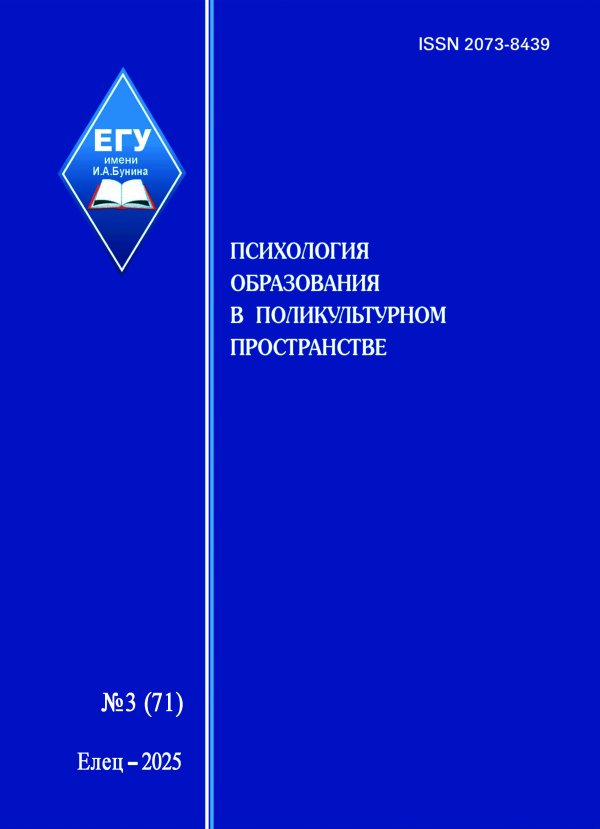
Educational Psychology in Polycultural Space
ISSN (print): 2073-8439
Media registration certificate: ПИ № ФС 77 - 35613 от 12.03.2009
Founder: Bunin Yelets State University
Editor-in-Chief: Nikolaeva Elena I. , Doctor of Sc., Full Professor
Frequency / Assess: 4 issues per year / Open
Included in: Higher Attestation Commission List, RISC
The journal offers a platform for discussion of current issues in educational psychology, pedagogy and cognitive sciences. The publication is designed to promote the development of educational sciences and pedagogical practice, the dissemination of advanced knowledge and experience in the field of education. We strive to provide open access to current research for the widest possible audience, to support a dialogue between representatives of different scientific schools and areas in pedagogy and psychology. The journal is aimed at researchers, university professors, school teachers, and postgraduate students engaged in research in the field of education.
Current Issue
No 3 (71) (2025)

PSYCHOLOGICAL SCIENCES
Motivation to achieve success and motivation to avoid failures among students of a pedagogical university in the context of a point-rating assessment system
Abstract
The article presents the results of an empirical study of the characteristics of moti-vation to achieve success and motivation to avoid failure among students of pedagogical uni-versities from different regions of the Russian Federation in various fields, profiles and train-ing programs in a point-rating assessment system. The differences in the motivation to achieve success and the motivation to avoid failure among students studying under the conditions of academic performance control using a point-rating assessment system and without it are shown. It is assumed that the point-rating system allows taking into account the individual and personal characteristics of students and eliminates the subjectivity of the teacher, however, on the other hand, when students systematically use it in the educational process, the level of mo-tivation for success decreases and the level of motivation for avoiding failures and protection increases. The article argues that the main reason for the decrease in motivation for success among students in the context of academic performance monitoring using a point-rating eval-uation system is the predictability of learning outcomes. The availability of evaluation tools in the funds of the rating plan, various tasks, exercises, creative works, as well as requirements for their implementation, assessment criteria, etc., allows the student not only to determine the level of difficulty of tasks, assess their strengths, adjust the individual educational route, but also to ―translate‖ the results of educational activities in the discipline into rating score points and predict the probability of your success or failure. As a result, the student's risk level and anxiety level decrease, self-esteem stabilizes, the desire for success becomes lower, and the motivation level for avoiding failures increases.
 7-17
7-17


Psychological resilience of generation Z to uncertainty
Abstract
This article presents an analysis of the results of an applied study on the psycholog-ical resilience and attitudes toward uncertainty among representatives of Generation Z. Ac-cording to the authors, psychological resilience is a complex personality characteristic influ-enced by a range of both subjective factors (such as value systems, worldview orientations, etc.) and objective ones (such as age, personality traits, etc.). Psychological resilience mani-fests itself, among other things, in an individual's ability to successfully cope with stress and crisis situations, among which uncertainty plays a particularly significant role. The authors agree with the idea of the modern world as unstable and uncertain, which influence the emer-gence of various human practices. Generation Z is developing within precisely such a worldview framework, which affects their strategies for coping with uncertainty. The article includes an overview of theoretical approaches to the concept of uncertainty, outlines the ge-nerational boundaries of Generation Z, and substantiates the relevance of studying psycholog-ical resilience within this demographic group. Through applied research, the authors identi-fied a correlation between the perception of uncertainty across different levels and domains of life and the resilience of the younger generation. Characteristic patterns were found and ana-lyzed, linking respondents’ personality traits with their understanding of uncertainty. The find-ings support the conclusion that representatives of Generation Z display certain vulnerabili-ties in their psychological resilience when faced with uncertainty in key areas of human inte-raction. It was also found that young people are generally more active in attempting to overcome uncertainty, primarily through value-rational strategies.
18-26
Features of self-organization of first-year students of college
Abstract
The widespread use of information technology and changes occurring in the life of society draw the attention of modern man to the need to increase the level of self-organization of his activities. An important task is to understand what changes occur in the development of the personality of stu-dents in different educational environments. In this regard, it is relevant to study the features of self-organization and reflexivity of students in different educational environments. The study was conducted in two stages: at the first stage, 80 ninth-grade students of Izhevsk schools took part, of which 40 tenth-grade students of Izhevsk schools and 40 first-year students of Izhevsk colleges subsequently became participants at the second stage. The study used the questionnaire "Diagnostics of Self-Organization Features-39" (A.D. Ishkov), "Reflectivity Questionnaire" (V.N. Karandashev), all data underwent mathematical and statistical processing using the Mann-Whitney U-test, correlation analysis of the Spearman coefficient. The study revealed that the indicators of the self-organization scales are presented differently in tenth-grade students and first-year college students. Significant differences were found in tenth-grade students and first-year college students on the scales "Goal Setting", "Situation Analysis", "Planning", "Volitional Efforts", "Level of Self-Organization". Significant differences were not found on the scales "Self-Control", "Correction" and the reflexivity indicator. In first-year college students, connections were found between reflexivity and the self-organization scales "Situation Analysis", "Level of Self-Organization". Tenth-graders showed a positive relationship between reflexivity and the "Goal Setting", "Correction" scale.
27-36
COGNITIVE SCIENCES
USING CERVICAL VESTIBULAR MYOGENIC EVOKED POTENTIALS FOR PREDICTING COGNITIVE AND MOTOR DEVELOPMENT OF A CHILD
Abstract
The article explores both theoretical and practical aspects of using cervical vestibu-lar evoked myogenic potentials (cVEMP) in psychology and psychophysiology. It highlights the role of the vestibular system not only in maintaining balance but also as an important con-tributor to cognitive and motor development in children. The cVEMP method is a neurophysi-ological technique that assesses the function of the saccule and the inferior part of the vestibu-lar pathway. Experimental data are presented on the application of cVEMP for diagnosing children with various developmental disorders and learning difficulties, such as long-term ef-fects of prematurity and complicated birth, severe speech development disorders, autism spec-trum disorders (ASD), and attention deficit hyperactivity disorder (ADHD). The article pro-vides evidence of the association between vestibular dysfunction and impairments in spatial memory, body schema formation, and other cognitive functions. It is shown that vestibular dysfunctions are not limited to children but also accompany brain aging and are characteris-tic of conditions such as Alzheimer's and Parkinson's diseases. The paper discusses the role of vestibular dysfunction as a potential biomarker of neurological disorders, the importance of spontaneous motor activity in the lives of children and adults, and the possibilities for correct-ing vestibular dysfunctions through psychoeducational interventions. Special emphasis is placed not only on movement but also on the use of rhythm and low-frequency music, as the saccule evolutionarily retains the ability to register loud low-frequency sounds. This so-called vestibular hearing supports cochlear hearing and plays a role in speech perception. These findings support the inclusion of cVEMP in diagnostic protocols for children and adults with various cognitive impairments. cVEMP can help identify vestibular system dysfunctions and monitor changes resulting from corrective and developmental interventions.
37-46
PEDAGOGICAL SCIENCES
METHODOLOGICAL SPECIFICITIES AND DIFFICULTIES OF TEACHING LATIN WITHIN AN “ENGLISH MEDIUM” PROGRAM
Abstract
At the beginning of this century English has gained the status of the international communication language. Many leading Russian universities offer education in English (an intermediary language), which makes it possible to neutralize the problems associated with ethnic and national diversity of students' groups. The manuscript objective is to analyze the methodological features and approaches to teaching English Medium Instruction program ―Latin Language and Fundamentals of Medical Terminology‖ to international students. Ma-terial and Methods: The study was conducted at the Northern State Medical University, which has been training international students since 1991. Theoretical methods including the analy-sis of literature sources and the discipline's educational and methodological complex were used. A survey of faculty members and international students was conducted. A general de-scription of the discipline is given. Each of its sections (anatomical, clinical, pharmaceutical terminology) is considered from the view point of teaching specifics in the intermediary lan-guage and characteristics of the material perception by international students. Linguistic as-pects of English interfering with the effectiveness of the discipline mastering by international students are explored. Difficulties that faculty members face when teaching international stu-dents are analyzed. The most interesting aspects of studying Latin and students' suggestions for improving the educational process are revealed. Conclusions: Teaching Latin in heteroge-neous, multi-level, multinational student groups with instruction in the intermediary language is a complex process due to: 1) limited class hours; 2) varying levels of international students' language proficiency; 3) the specificity of anatomical, clinical, and pharmaceutical terminol-ogy requiring instructors to know numerous synonyms for explanation; 4) linguistic differenc-es between Latin and English systems; 5) the need for methodological approach adaptation.
47-55
PHILOSOPHICAL ANALYSIS OF DIGITAL TRANSLATION TEACHING MODELS FROM THE PERSPECTIVE OF PRAGMATIST PHILOSOPHY OF EDUCATION
Abstract
The rapid development of global digital technology needs to be combined with the philosophical reasoning embedded behind it in order for the technology to better serve the human translation education industry. This study takes the philosophy of pragmatism educa-tion as the theoretical basis to develop a deep philosophical analysis of the digital translation teaching model. The methodology of this study mainly utilizes theoretical analysis and logical deduction. The theoretical analysis method is used to find out the intrinsic connection and in-tegration point between pragmatism education philosophy and the digital translation teaching mode. The logical deduction method is used to deduce the theoretical connotation and imple-mentation principles of the digital translation teaching model based on the core principles of pragmatism. Based on the core principles of pragmatism: ―education is life‖, ―school is so-ciety‖ and ―learning by doing‖, we deduce that the digital translation teaching mode should focus on creating real or simulated translation contexts; emphasize collaborative and interac-tive learning; and be learner-centred. We deduce the theoretical connotation of the digital translation teaching mode from the perspective of pragmatism education philosophy: the di-alectical unity of technical tools and learners' subjectivity; problem-oriented translation teaching; the unity of interaction and feedback; the unity of experience and practice. The im-plementation principle of the digital translation teaching mode from the perspective of prag-matism education philosophy should adhere to the implementation principles of learner-centredness; contextualized teaching; reflective practice; and continuous assessment. The study provides a solid pragmatist philosophical foundation for the construction of the digital translation teaching mode; it provides philosophical reflection on digital translation teaching practice.
56-62
Polycultural development of personality of mentor as value: problems, solutions, perspectives
Abstract
Global transformations of nowadays are taking place in the frames of the world community. Crucial information processes and continuous communication, the need in integration of nations and people, cooperation of regions are hallmarks of social realia of modernity. As is the case, the processes of disintegration, the lack of authentic comprehension, and the neglect or the lack of traditional values of a man, take place gradually. And these phenomena as processes are taking place within the framework of topicality of the problem of security of a personality, for all the people, in the area of polyphony of cultures and languages. The aim of this paper lies in the topicality of upgrading the methodology of the dynamics of pedagogical activities research within the innovation concept structure of the language of national educational system/its processes which take place in the practices of educational institutions, mentors as top managers, and educators, including their general and professional culture. The research methodology covers the theoretical justification, generalization and analysis of the database obtained, and the design of the educational process within the integration approach as a value. The interest lies in the context that concerns the data observed within the fundamental research works dedicated to some of the possible means for people to find themselves in the culture spaces within authentic humanitarian communication practices based on the personification principles for language personality development. Research outcomes present generalized vision of current humanitarian practices on the polyculture development of a personality of a mentor. This is important nowadays when there exists a great need for both in highly qualified professionals and creative personalities in terms of a) architectonics of the image of polyculture picture world of a mentor/tutor of educational community as a reflection of his polyfunсtional actions; b) social identity of a personality of a mentor presents some of the value dominants of novel paradigm of recurrent polyculture education within a secure polyculture space. In conclusion the main final concepts of the research are formulated regarding the need to update authentic culture activities based on the system approach as a mechanism for axiology and personification of professional educational process via polycuture as a value for language personality to be acquired for self-organization.
63-71
Significance of combinatorial rules in the theory and methodology of foreign language education in the context of digitalization
Abstract
The article formulates combinatorial rules, conceptualized as a cybernetic tool (a management instrument) that supports the motivational, functional, and substantive organization of foreign language education, ensuring its overall suitability in the context of digital transformation. It highlights the benefits of employing combinatorial rules from a digitization perspective and emphasizes their significance in implementing the hierarchical system of principles underlying foreign language education. Fundamentally, it outlines a pathway for the essential and timely alignment of foreign language education objectives with the methods for achieving them. The author argues that addressing a key national priority in foreign language education—its digitization—requires a more thorough and nuanced examination of the theory and methodology of foreign language education. The article notes that the current digital formalism and limitations of methodologies in digital environments stem from insufficient reliance on mathematical principles. The author contends that the theory and methodology of foreign language education, as an independent discipline with its own theoretical foundation, can apply mathematical principles in the field of methodological cybernetics through combinatorial rules. These proposed rules enable the generation and structuring of configurations of methodological factors, ensuring adaptability to educational goals and learners’ individual characteristics. Consequently, this approach unlocks the scientific and innovative potential of managing process while enhancing the effectiveness of the educational process. The article further emphasizes that the existing concept of combinatorial linguodidactics, while valuable for analyzing linguistic structures, does not fully address the range of methodological challenges associated with managing the educational process. The application of combinatorial principles offers the potential to reduce entropy and foster the continued development of methodology as an autonomous academic discipline.
71-79
Psychological states of students and tasks aimed at reduce stress, increase self-regulation and procrastination management in foreign language classes in non-linguistic area
Abstract
The article examines the psychological states that students experience during the learning process, assesses academic procrastination, stress and the level of self-regulation that affect the activities of students in the educational environment. In order to identify the level of self-regulation, stress resistance and procrastination in the 2024-25 academic year, testing of 1st year students was conducted. The results of the assessment of psychological states obtained in the course of the study (analysis of the level of self-regulation, stress resis-tance and procrastination of students) contributed to the formation of a deeper understanding of the psycho-emotional climate of students and the reasons for their academic failure and negative attitude towards the educational process among teachers. These data formed the ba-sis for the development of methodological recommendations and techniques aimed at adapting the content of training in the discipline in order to overcome the above difficulties. The article provides examples of tasks and work modes for foreign language classes. One of the key tasks of a foreign language teacher is not only to transfer knowledge and develop skills, but also to create conditions for the psychological well-being of students, especially at the initial stage of training. In foreign language classes, difficulties that cause stress can be divided, including aspects (vocabulary, phonetics, grammar) and also by aspects to work purposefully, overcom-ing the stress of students. Using techniques aimed at eliminating "incomprehensible" frag-ments in the educational material, you can significantly reduce the level of anxiety of students and increase their self-confidence. Reducing the fear of misunderstanding will contribute to more effective acquisition of the language.
80-92
Resilience as a factor in successful socio-psychological adaptation of future teaching staff to university studies in the context of a Special military operation
Abstract
The article contains an overview of scientific publications on the development of resilience among students of Russian educational institutions. The author reviews the importance of resilience in the process of professional development of students, future teachers, and their integration into the Russian educational space. It is emphasized that the resilience of future teaching staff is a factor in the psychological safety of the educational environment. The high level of resilience allows to cope with stressful situations in the process of adapting to university studies and future professional activities. The definition of resilience and its structure are given in accordance with the concepts of S. Muddy and D.A. Leontiev. The results of studying resilience at the preparatory stage of the program of socio-psychological adaptation of future teachers in the context of integration into the all-Russian educational space are presented. The study was conducted among students of pedagogical universities located in two historical regions (Zaporizhia, Kherson region) and two other subjects of the Russian Federation (Perm Krai, Tomsk region). The indicators of control and risk acceptance are lower among students of historical regions than among students in other regions of the Russian Federation, which suggests that there are some difficulties in managing their lives or studies. The average level of indicators on the ―risk acceptance‖ scale is typical for students who are ready to act, provided they are guaranteed success and are convinced that any acquired experience in life contributes to further growth. The average score for general resilience is 22.6 points for students in historical regions, which is less than in the other group (23.5). This confirms the assumption that students in other regions of the Russian Federation have a higher overall resilience, which can contribute to better adaptation to learning, stressful situations and challenges.
93-101