



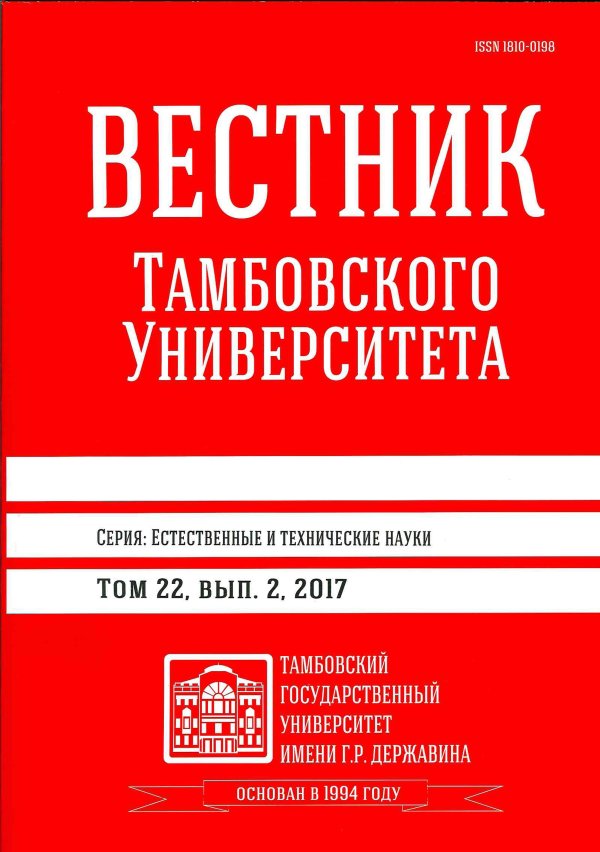
Vol 22, No 2 (2017)

Articles
About asymptotic representation of one task of flow fluid dynamics decision
Abstract
The initial boundary-value problem of hydrodynamics in a plane with a barrier, considered in the article, continues a series of studies aimed at studying the asymptotic properties of solutions of nonclassical problems of mathematical physics, such as in [1]-[6]. The urgency of the work lies in the study of the smoothness of solutions in the presence of discontinuities in the boundary conditions. The main goal is to study the behavior of the solution of the problem, as well as its first derivatives in the neighborhood of the boundary. The study is based on the method of transition to the generalized problem and the theory of MacDonald-Bessel functions. Under certain conditions, the singular terms of the solution components and their derivatives are singled out.
Russian Universities Reports. Mathematics. 2017;22(2):434-438
 434-438


Modeling of combinatorial problems with the help of continuous logic
Abstract
In this paper we formulated the class of combinatorial tasks, which equivalent to problem of determining the relative position of slot sequences. We propose examples of this class of problems related to the field of synthesis of reliable devices by redundancy, organization management of customer service in trading systems, drafting proper timetable of dissertation council. We give precise mathematical formulation of problem, consisting of the analysis part (determining the actual position of interval sequences) and synthesis (finding location conditions for interval sequences at which their relative positions form a desired order). The mathematical model of dynamic finite automaton without memory as a logical -pole is introduced. The main task for this automaton is to find the output dynamic process by known input processes and implemented logical (Boolean) function. Detailed description of continuous logic as mathematical means that allow find the output dynamic process in automata is given. Examples of such a finding are presented. It is shown that the dynamic finite automaton without memory is adequate mathematical model to solve the combinatorial problem. At the same time the original combinatorial problem reduces to finding the output process in the automata model, based on the specified input processes and implemented logic function. An 6-step algorithm for solving the problem, as well as two examples of combinatorial problems that are solved by this algorithm are proposed. Both examples are solved in analytical form. We release the estimation of computational complexity which implies that the complexity of the proposed approach is growing as a power function of the dimension of the problem. So the approach is applicable to the solution of problems of high dimensionality. The advantage of the approach else in the ability to formally seek algorithms for solving problems and analyze probable solutions by finding the necessary and sufficient conditions for existence of such solutions.
Russian Universities Reports. Mathematics. 2017;22(2):439-448
439-448
EXPERIMENTAL SETUP TO STUDY THE DRIVE OF THE INDUSTRIAL ROBOT OF LATHE ROBOTIC COMPLEX
Abstract
The questions of experimental studies of electrohydraulic linear drive industrial robot to automate the operations of “loading and unloading” the robot in the CNC lathes are considered. Experimental studies are carried out in order to verify in practice the method of calculation of the drive. The proposed experimental setup made it possible to approximate the nature of the drive to the operating conditions.
Russian Universities Reports. Mathematics. 2017;22(2):449-453
449-453
The study of E-I characteristics of semipermeable membrane MGA-95P, OPM-K and OPMN-P
Abstract
The researches on study of E-I characteristics of semipermeable membrane MGA-95P, OPM-K and OPMN-P in process medium of copperplating process are fulfilled. Experimental researches are carried out at installation with separation module. Module is two-chamber interface membrane apparatus of plate-and-frame type. In accordance with the received data the dependency diagrams of charge density from stress for solutions with copper ions and trisodium phosphate of different density were made. We see from the experimental data that all E-I correlations have dependence close to linear of charge density from stress. The implication of charge density do not have critical points, as in characteristic curve there are no inflection points. With the growth of concentration of dissolved solids in all the studied solutions charge density was also increasing.
Russian Universities Reports. Mathematics. 2017;22(2):454-458
454-458
Fullerene-containing material received by low-temperature cracking from rubber-containing wastes
Abstract
The processing of rubber-containing products has an interest from an ecological point of view. In addition, it has been shown that the method of low-temperature catalytic cracking makes it possible to obtain fullerene-containing material from rubber-containing wastes, which opens up prospects for improving of the production of fullerenes. Such carbon material was obtained using the technology developed in 2009-2011. Using X-ray diffraction analysis, it was found that it contains about 3 % C60 fullerene. This substance is characterized by high porosity and good sorption properties, for the study of which it was activated by the hydrothermal method. Especially good sorbent showed itself in the case of absorption of iron nitrate. The powder of the fullerene-containing material was compressed at the pressures from 20 to 50 atm. The resistivities of the resulting material, depending on the compression pressure, are 3-10 Om×cm. After studying of the current-voltage characteristics of the pressed substance, it was found out that its resistivity first increases (at pressures of 20-40 atm), and then decreases. Changes in specific conductivity, along with high sorption capacity, suggest the possibility of using of the carbon material in sensors and sensory devices. The activation energies were 0.06-0.15 eV for the uncompressed substance and 0.02-0.04 eV for the compressed at the pressure of 40 atm.
Russian Universities Reports. Mathematics. 2017;22(2):459-463
459-463
Metody neinvazivnogo izmereniya vnutrenney temperatury tela
Abstract
Актуальным является бесконтактное получение клинической информации в текущем режиме с компьютерной обработкой результатов в удобной для врача форме без вредных воздействий на организм больного. Измерение внутренней температуры тела может дать уникальную диагностическую информацию. В обзоре проведено рассмотрение и сравнение методов неинвазивного измерения внутренней температуры тела на нынешнем этапе. Описаны такие методы, как магниторезонансная (ЯМР) термометрия, СВЧ-радиотермометрия, акустотермометрия. Дана информация о принципах расчета глубинной температуры в каждом из методов. Предложено сравнение методов по пространственному, временному разрешению, точности определения температуры, стоимости аппаратуры. Приведены достоинства и недостатки методов в плане клинических приложений.
Russian Universities Reports. Mathematics. 2017;22(2):464-470
464-470
471-478
PERFORMANCE EVALUATION FOR MEASURING MEASURES NORMABILITY
Abstract
The optimum measure of evaluating the effectiveness of innovation as an example of multisymmetric criterion represented by the ratio of the geometric mean of the test count to the arithmetic mean of equivalents to improve the reliability of sites-efficiency of information technology work is proposed.
Russian Universities Reports. Mathematics. 2017;22(2):479-485
479-485
THE ALGORITHM OF STATISTIC ANALYSIS OF CHARACTERISTICS
Abstract
The algorithm of statistic analysis of analogs according to grading characteristics of a set of unrationed variables of measurement and monitoring of non-linear diagrams for creation of automatic computer design technology analyzers of information processes is analyzed.
Russian Universities Reports. Mathematics. 2017;22(2):486-492
486-492