



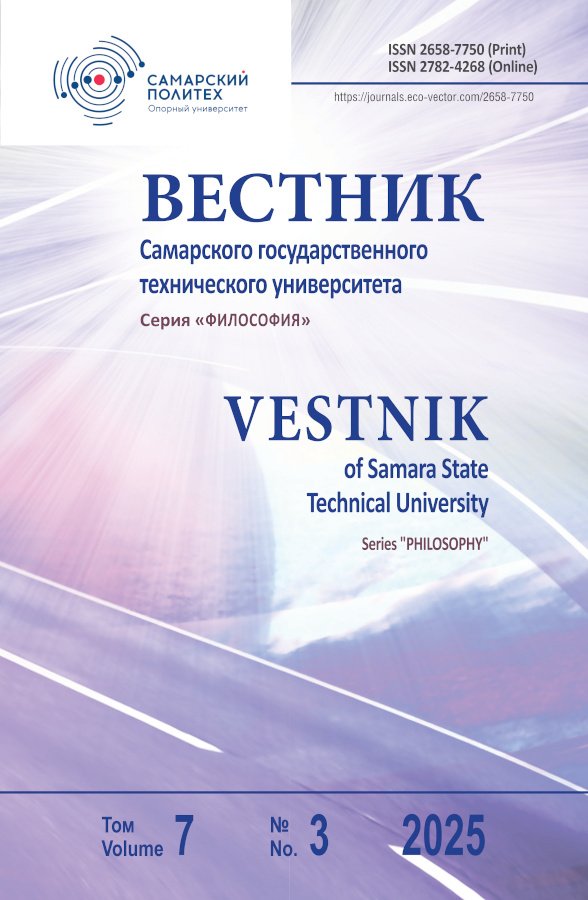
Vestnik of Samara State Technical University. Series Philosophy
The journal has been founded in 2019. At the present day the journal founder is Federal State-Funded Educational Institution of Higher Education Samara State Technical University. Registration Certificate "PI № FS77-68052" dated 13.12.2016. The journal was assigned the international number of periodicals ISSN 2542-0151.
Articles submitted for publication in the journal are subject to mandatory independent review, the reviewers are members of the editorial board and leading Russian scientists working in the field of scientific topics of the journal.
The journal is published once a quarter (four times a year) in the following enlarged sections "Philosophy", which includes the following thematic headings:
- 5.7.1 - Ontology and theory of knowledge
- 5.7.2 - History of philosophy
- 5.7.7 - Social and political philosophy
All questions on manuscript submission are to be referred to Isaev R. O., the executive secretary of the journal , romanceisaev@gmail.com
Edição corrente
Volume 7, Nº 3 (2025)

ОБЩЕСТВО. КУЛЬТУРА. ЧЕЛОВЕК
Factors of concealment of the socio-cultural essence of the house in their interrelation
Resumo
The phenomenon of home has acquired a new meaning and becomes a relevant object of philosophical, scientific and systemic research. The article proposes to analyze the house from the sociocultural point of view of dialectical orientation. This approach allows us to consider the most famous and diverse phenomenon as an integral system of society. But instead of the traditional metaphor of “idols” of cognition, which hinder the cognition of the essence of phenomena, the metaphor of “guards of the house” is proposed, which shows the activity and diversity of acting causes. These guards protect the essence of the house as a universal sociocultural system of society, not as a local phenomenon. So far, this essence is hidden by stereotypes of ordinary consciousness, special disciplines, intuition and house-building practice. Therefore, the aim is set: to reveal the epistemological guardians of the house in their interrelation. In this the author sees the novelty of his goal and the obtained results of the analysis. It is shown that stereotypes are the greatest restraining force that does not allow to reveal the essence of the house as a socio-cultural integral system. The explicit guardians of the sociocultural essence of home are the manifold disciplinary and practical definitions of home. The hidden factor in concealing the sociocultural essence of the house is intuition. The fact is that intuition itself as a form of cognition is formed by the spiritual experience of house-building, the ability of the house to be the starting point of orientation in the world and its cognition. In the process of revealing the integral sociocultural nature of the house, digital technologies have acquired a contradictory significance: they allow to act as a sociocultural model of the house system and, at the same time, to displace a person from the real sociocultural system of houses. As a result, the human being loses his real subjectivity. The sociocultural approach to revealing the factors of concealing the essence of the interconnection of houses allows us to adjust the strategy of solving the housing problem in society. The prospects of research of modern information technologies in concealing and in revealing the essence of the house as a sociocultural system of society are shown. The materials of the article are recommended for use in the development of house building projects of various levels.
 5-14
5-14


From information ethics to digital law
Resumo
The purpose of the article is to investigate the evolution of ethical principles in the context of the rapid development of information technology. The problem involves an interdisciplinary approach: a combination of philosophy, law, information technology and business ethics. The article shows the evolution of ethical principles in the context of the rapid development of information technology. In the context of the formation of the information society, ethics was close to the traditional universal ideas of good and evil. With the introduction of information technology in business, a new instrumental ethics function has appeared. Ethics has become a prerequisite for business success. This is no longer an intimate part of the spiritual world of a person, but an instrument of business action. At the same time, traditional moral principles were adapted to new business realities. The usual ethical standards were filled with new content. In the context of a modern digital culture, in the center of which are modern versions of artificial intelligence, adaptation processes are included in the most complex social problems, which leads to a convergence of ethics and law. Modern technologies, primarily the development of artificial intelligence, abolishes the traditional view of technology as a continuation of the human will. The autonomy of technology is growing. (For example, autonomous weapons systems can make decisions without human intervention about who is left alive and who is not. In the context of autonomous cars, the algorithms themselves choose what to do in an accident situation). The more autonomous technologies, AI systems become, the less a person controls their behavior. AI autonomy limits our ability to intervene with a critical, for example, situation. The path of development of artificial intelligence goes from the function of the tool to independence, i.e. the function of the subject. There are risks of losing control of technology. If the autonomous system decides to interact with the environment and learn without direct human participation, then the question arises who is responsible for their actions. In this case, is AI a tool or a subject? In the event that the AI system is mistaken, then who is to blame for this: developers, users, or the system itself. For example, in the case of a doctor who relies on AI when making a diagnosis, then if the diagnosis is erroneous, who is responsible – the doctor or the algorithm. The moral dilemmas associated with the use of artificial intelligence require the development of ethical standards that would regulate the behavior of "machines" – algorithms. In certain situations, moral norms are not enough, legal norms (information law) begin to enter into force.
15-27
Network culture of the modern information society
Resumo
The dynamics of the information and communication technologies development has led to the emergence of a new kind of culture. Revealing the essence and specifics of the network culture functioning is becoming one of the urgent task aimed at maintaining social stability. The author has carried out a conceptual and theoretical understanding of modern trends in the development of the information society by clarifying the qualitative specifics of the network culture phenomenon in the article. The aim of the article is to develop a socio-philosophical concept of network culture that can serve as a basis for ensuring information security for the development of the individual and society. The methodological basis is the network approach, which focuses on social relationships and interrelations that determine the specifics of people's network interaction. The universality of its application in this article lies in the fact that it helps to reveal the structure of the network, which determines the features of the stability and intensity of contacts of subjects, its transitivity and openness. The axiological method and forecasting method used in the article made it possible to reveal the specifics of the value-normative interaction of network elements, the features of the formation and functioning of network culture in comparison with the mechanisms of the traditional culture existence, and to anticipate future opportunities for its development to prevent destructive effects on social processes. The result of the research was the identification of such essential features of network culture as globality, anonymity, interactivity, creativity, dynamism, flexibility, openness, multimedia, which determine the peculiarity of its formation and existence. Their clarification is aimed at the formation of network ethics, focused on the development of a new system of social values and norms in accordance with the specifics of the network society. This article can be recommended in the development of measures to preserve the information security of social development, which is practically in demand in modern society, the stability of which is negatively affected by the destructive use of information and communication technologies.
28-36
Sublimation of identity in the context of psychoanalytic theory of personality
Resumo
The article discusses the phenomenon of personal identity from the point of view of its reflection in the fundamental concept of describing intra-subjective individuality, namely, in the psychoanalytic theory of personality, the degree of development of which today is the link between practices in the field of psychoresearch and philosophical research on subjective self-perception and self-determination. The author of the article describes the chronological transformation of ideas about the phenomenon of personal identity in accordance with the development of psychoanalytic theory, which is currently a very pressing issue, because the instability of modern culture encourages scientific research in terms of subjective self-determination to be reinforced by near-philosophical knowledge systems – fundamental cultural studies, theoretical sociology, socio-cultural anthropology, general and cognitive psychology and, of course, psychoanalysis and psychoanalytic practice in one or another of their interpretations. The purpose of this article is to trace the theoretical transformations in the ideas about the phenomenon of personal identity from the point of view of its explication in the psychoanalytic theory of personality. The formulated goal predetermined the research methods, among which are the method of theoretical reconstruction, the result of which is a retrospective reproduction of the logic of psychoanalytic research in the field of self-determination of the subject, and the method of system analysis, which allows for a comprehensive and complex consideration of the phenomenon of personal identity in its psychoanalytic context. The presented work focuses on such psychoanalytic concepts as Sigmund Freud's triune psychic system, which divides the personality into three key components: the Id, the Ego, and the Superego; Carl Gustav Jung's collective unconscious and archetypal construct, which suggest that the subject has universal images and motives that influence the individual perception of identity; Nikolai A. Berdyaev's creative acts, which are the most important manifestation of individuality and open new horizons for understanding identity, emphasizing the importance of subjective experience and inner freedom; Jacques Lacan's mirror stage, which illustrates how subjective interaction with the Other shapes the idea of oneself; Andre Green's dead mother, which symbolizes a radical change in the perception of identity on a deep emotional level. It is proved that the crisis of personal identification of the subject has a validity and consistent logic of its existence in the next to modernist ideas about subjectivity – postmodern culture and postmodern philosophy.
37-47
ФИЛОСОФИЯ И МЕТОДОЛОГИЯ НАУКИ
Aesthetics and aesthetic gnoseology as a subject of cognitive theory in the field of engineering
Resumo
The relevance of the article is due to the fact that in the expanding field of modern theory of knowledge, such a concept as "aesthetic gnoseology" finds its place, which is interpreted by the author of the article as a special field of cognitive activity, providing for a close connection between science, technology, engineering and philosophical aesthetics, which presupposes the perfection of sensuality, art, creative activity with a focus on beautiful thinking with images, what is necessary in scientific and technical activities. The discovery of scientific theories, the appearance of scientific works that arise with the exertion of the mind, feelings, and the burning of emotions, as well as in art, require aesthetic agreement of thoughts, harmony, perfection, and beauty. The methodology of aesthetic gnoseology is based on an anthroposocioecological approach that ensures the reliability of research on the relationship in the meta-system of science, technical engineering and art. This model of metasystem is increasingly finding a place in urban planning and the organization of large public spaces. The purpose of the article is to introduce the concept of aesthetic gnoseology into scientific usage. In the first part, "Introduction to aesthetic gnoseology", the task was to show that modern philosophical knowledge implements the continuity of aesthetics as a philosophical science of sensory cognition, born by A.G. Baumgarten. In the main part, devoted to "algorithmic aesthetics as a link between art and engineering," the article demonstrates the advancement of philosophical and gnoseology thought about the convergence and integration of science, art and technology, representing a single meta-system that has become the subject of aesthetic gnoseology, necessary in solving art projects carried out in the modern digital space. Attention is drawn, on the one hand, to the features of algorithmic aesthetics as the basic basis of digital art, and, on the other, to the connection of aesthetic experience with engineering, citing the genius of V.G. Shukhov as an example. In conclusion, the author emphasizes the value of Baumgarten aesthetics and the role of aesthetic epistemology in improving the sensory perception of the world and thought processes through the development of imaginative thinking, which is necessary both in art and engineering. As for aesthetics as a science, it has come a long way from Bamgarten's gnoseology aesthetics, then the philosophy of art, to a broad problematic aesthetic knowledge that takes place everywhere and includes aesthetic gnoseology. The very aestheticization of life in search of new harmonious ways of shaping requires the consent of thoughts and actions, order in qualitative, stable expression.
48-57
Phenomenology of intersubjectivity and cognitive architecture of artificial intelligence
Resumo
Phenomenological studies of intentional structures of subjective reality are one of the necessary theoretical and methodological resources for building artificial intelligence systems. The article provides a summary of the principles of the classical phenomenology of intersubjectivity and analyzes their application in one of the projects for building a cognitive architecture of general artificial intelligence. In E. Husserl's phenomenology, the intentional structures of transcendental intersubjectivity are given the status of the ontological and semantic primary basis of reality. However, in E. Husserl's concept, these structures are interpreted as immanent interrelations of the field of transcendentally pure consciousness. For Hegel, the structure of the formations of consciousness is formed by the development of the total spiritual culture of mankind. The primary, fundamental fact of the experience of self-awareness is not the cogito, but the experience of being-for-oneself and being-for-another. In my very being, I am dependent on the other, my consciousness at its very center must be mediated by another consciousness. Hegel's approach to the phenomenology of intersubjectivity and its role in the formation of consciousness can be considered as a philosophical justification for the concept of building a cognitive architecture of intersubjectivity in the international project of creating an artificial intelligence system RoboErgoSum. In this project, the objective qualities of objects are revealed through possible actions with these objects. For successful joint actions, interaction agents must be able to coordinate their intentions, plans, goals, and actions. In the same process, there is a perception of oneself as different from the environment, which is the basis of human self-awareness and its robotic model. The project developers insist that in their project robots acquire consciousness and self-awareness, develop the ability to build internal models of the world, to reason and reflect, self-control, goal setting and motivation, achieve an understanding of what is happening, etc. The article concludes that such anthropomorphisms are acceptable only as a metaphorical language of discourse. In fact, we should be talking about modeling higher human mental functions (perceptual, cognitive, affective, predictive) in the cognitive architecture of artificial intelligence. A crucial role in the formation of structures of this kind of integrated intersubjectivity is assigned to the process of artificial intelligence training based on the coordination of robot actions with human actions.
58-65
Reading, writing, vision: a philosophy of knowledge
Resumo
The article is devoted to the problem of knowledge beyond human existence. The question in this formulation is removed from the agenda without being solved. Traditionally, knowledge is interpreted as a property of consciousness corresponding to reality; with the emergence of cybernetics, knowledge began to be reduced to information. Both approaches should be recognized as erroneous. Knowledge is not a fact of consciousness and is not reducible to information. The relevance of the topic of the article is predetermined by overcoming traditional misconceptions. The scientific novelty of the article consists, firstly, in the fact that “being” in the traditional metaphor of a warehouse (workshop) is replaced by “being-under-view” in the metaphor of an exhibition. The world is not a warehouse, but an exhibition. There is no “being”, there is “being-under-view”. Second, the original form of knowledge has nothing to do with consciousness, but is an epiphenomenon of “demonstrative behavior” on the part of any “thing”. Being-under-view is demonstrative; in the very fact of demonstration lies the effect of 'knowledge'. Demonstration a priori requires an “observer”, whose figure does not appear in physics by chance. Thirdly, the concept of information does not replace the concept of knowledge. Information is recorded knowledge; it is for this reason that information is incalculable, while knowledge is incalculable. The methodology of the author's research is based on the experience of historical-philosophical and aesthetic studies, cultural analysis of trance cognitive practices and the culture of physical and mathematical thinking due to the basic education received. The aim of the article is to develop a new approach to understanding knowledge beyond human existence. To achieve this goal, a number of tasks are addressed, including a search for appropriate terminology and a critique of familiar theses. The terms in the conceptual meaning of the author's approach to the theory of objective knowledge include “being-under-view”, “exhibition”, “exhibit”, “demonstration”, “reading”, “sign”, “vision”. Practical application of the results of the article is possible in the field of physics (concerning the problem of existence), in the field of theory of cognition (the problem of objectivity of knowledge), in the field of education. Semi-education has long been the “norm”, especially when reducing knowledge to information. Science suffers from semi-education no less than education, closing in the accepted “paradigms”. The most damaging paradigm for modern science is reduced to the metaphor of a “warehouse” in understanding the world. The concept of “knowledge” does not fit into the paradigm of the warehouse worldview – for this reason, interest in the topic of “knowledge” in science and philosophy has practically dried up.
66-79
ФИЛОСОФЫ РОССИИ: ЖИЗНЬ И ТВОРЧЕСТВО
Historical and philosophical essay on the research of socio-technological development of the world
Resumo
The article is devoted to the analysis of historical and philosophical studies of the socio-technogenic development of the world by scientists of the "Bryansk scientific and philosophical school of research into the socio-technogenic development of the world, socio-techno-natural processes and changes in the evolution of life." It is shown that this phenomenon continues to be a center of attraction for scientists. In the era of rapid globalization, all-encompassing digitalization and the growing challenges of climate change, issues related to socio-technogenic development are becoming increasingly relevant. The emergence of new technologies, such as artificial intelligence and biotechnology, poses a number of philosophical problems for humanity that require deep understanding. The article shows that the research of the Bryansk scientific school concerning the socio-technogenic development of the world is complex and multifaceted. It covers not only the material aspects of progress, but also fundamental issues of ethics, morality and human responsibility to future generations. Research in this area allows not only to understand how technologies influence society, but also to identify potential risks and opportunities that they carry, since socio-technogenic development considers the interaction of man and technology as a central aspect of the formation of modern industrial and post-industrial society. The article shows that multidisciplinary research involves the synthesis of knowledge and methods from various fields, such as philosophy, sociology, economics, political science, history, ecology, etc. This approach allows us to see the problem in its entirety. The combination of various expert opinions and approaches contributes to the creation of innovative and comprehensive solutions that take into account all aspects of the problem. Multidisciplinary methodology is an integral part of modern scientific research. It opens up new horizons for understanding and solving complex problems facing humanity in the 21st century. In the context of globalization and the expansion of the technosphere, it is important to continue to pay attention to the socio-natural and socio-technological aspects of change in order to ensure a harmonious and fair future. This is a phenomenon that covers the interaction between technology and social structures, determining the paths of evolution of human society and the biosphere. In order to adequately respond to these challenges, it is necessary to rethink our philosophical principles. We need to define new principles that will regulate human interaction with technology and guarantee the sustainable development of society. This will require an open dialogue between scientists, philosophers, politicians, business representatives and the public.
79-90
АКТУАЛЬНЫЕ ПРОБЛЕМЫ РУССКОЙ ФИЛОСОФИИ
To the question of the relationship between soviet and Russian religious philosophy
Resumo
The paper examines the relationship between Soviet and Russian religious philosophy in the context of prospects for further development of modern post-Soviet philosophy. The relevance of the study is determined by the fact that the solution to this issue can determine the strategy for the development of philosophy in Russia for a long historical period. The scientific novelty of the work lies in the substantiation of the author's vision of the optimal version of such a strategy. The purpose of the study is to critically examine the main options for solving the issue of the relationship between Soviet and Russian religious philosophy, formulated in the works of modern Russian philosophers, which is necessary to substantiate the author's version of solving this issue. In this case, dialectical and hermeneutic methods are used, as well as such general logical methods as deduction, induction and analogy, analysis and synthesis. The study examines the concepts of the relationship between Russian religious philosophy and Soviet philosophy as elements of a dispositive (V.Yu. Bystrov and V.M. Kamnev), as a sequence of historical stages of dialectical development of one of the branches of philosophy that is international in nature with the Russian “national style” (A.V. Chernyaev), as two historical stages of the formation of professional (scientific) philosophy in Russia in the course of its struggle with the “growth” of Russian religious philosophy that hinders its free development (S.N. Korsakov). The author points out that these historical stages of the development of Russian philosophy are incommensurable, since Russian philosophy is national, and Soviet philosophy is one of the stages in the historical development of the international philosophy of Marxism, which is global in its scale. Therefore, Russian religious philosophy and Soviet Marxist philosophy cannot be components of a single philosophical tradition; the second historically displaces the first, being, in turn, displaced by modern post-Soviet philosophy. It is further stated that in the modern world there is a confrontation between two historical trends – globalization and fragmentation. At the same time, modern science is one of the most striking manifestations of the first trend, while modern religion is the second. Since Russia historically occupied an intermediate position between the East and the West, it cannot today clearly define itself between science and religion. Accordingly, modern Russian philosophy cannot be either scientific (analogous to Western positivism) or religious (analogous to Indian philosophy). The most organic variant of development for it is existential philosophy.
91-99
GRADUATE STUDENT TRIBUNE
The problems of artificial intelligence in the information and technogenic society
Resumo
The aim is to study the genesis of ideas about artificial intelligence in historical and socio-philosophical discourse, especially at the present stage of information and technological development of society. The methodological basis of this research is three approaches: socio-natural, interdisciplinary and post-turing methodology of artificial intelligence. The socio-natural approach, based on the theory of V.I. Vernadsky's philosophy of the biosphere and noosphere, makes it possible to assess the interrelated changes in the spheres of natural and social life caused by anthropo-man-made activities, as well as the connections between these spheres. The sociotechnological approach is emerging at the beginning of the 21st century in the research of the Interdisciplinary Scientific and Philosophical School of the socio-technological development of the world and the changing evolution of life, recognized by the Russian Academy of Sciences, supporters and followers of the school. This approach, in addition to society and the biosphere, also covers the expanding technosphere, that is, the artificial world formed as a result of innovative and technological social development of man. The beginnings of this environment are formed back in the agrarian period at the time of the formation of the productive economy of a traditional society. This methodology describes the interrelation and mutual influence of all three components: "socio", "techno" and "bio", occurring both in the present and in the past, which makes it possible to predict their integrated further development. The post-Turing methodology is based on the idea of developing artificial intelligence technology, the limitations of Turing testing of modern intelligent machines, and the problem of differences between the naturalness and artificiality of technologies. The development of the world is currently socio-technological in nature, based on the potential of intelligent machines and significantly transforming society and the biosphere. The emergence and development of new technologies has a significant impact on all areas: "socio", "techno", "bio". Today, artificial intelligence brings both benefits and harm to the information and man-made society, as well as to the natural environment, which is manifested in the increasing problems in the information and man-made society. Consideration of the origins of the emergence and development of artificial intelligence makes it possible to determine the socially determined nature of the problems and the directions of its evolution, as well as to predict the features of the influence of AI on society and the biosphere, outlining ways to harmonize their interaction. The theoretical and/or practical significance lies in the possibility of further transition to the consideration of artificial intelligence in a narrow and broad sense as the basis of socio-technological development of the world.
100-117
The birth of philosophy from the genesis of tragedy
Resumo
The study is devoted to the analysis of the genesis of ancient philosophy, in particular, the influence of tragedy on the formation of Plato's philosophical thought. The relevance of the work is due to the need for an in-depth understanding of the origins of philosophy as an independent discipline, as well as the relationship between cultural, mythological and philosophical aspects of the ancient world. The novelty of the study lies in the consideration of Plato's philosophy as a result of rethinking the ancient tragedy and its key elements – mimesis and catharsis. The author offers an original view on the process of “privatization” of theory (θεωρία) by philosophy and its transformation from religious and mythological context into intellectual practice. The paper aims to trace the process of the formation of philosophy as an independent discipline through analyzing the influence of ancient tragedy on Plato's philosophical system, and to identify the key cultural and mythological preconditions of this process. The work uses historical-philosophical, cultural and comparative approaches to examine ancient philosophy in the context of its cultural and mythological origins. Special attention is paid to analyzing the works of O.M. Freidenberg, M. Heidegger and other researchers. The study is based on the analysis of texts of ancient authors (Plato, Aristotle), as well as modern interpretations of their works. The methods of historical reconstruction, conceptual analysis and intertextual comparison are used. The author concludes that Plato's philosophy is formed on the basis of rethinking the ancient tragedy, its key elements – mimesis and catharsis. Plato transforms the pre-philosophical understanding of θεωρία (contemplation) into intellectual practice, which becomes the basis for distinguishing philosophy as an independent discipline. The results of the study can be used in courses on the history of philosophy, cultural studies and ancient literature, as well as for further study of the relationship between philosophy and culture. A promising direction is an in-depth study of the influence of other elements of ancient culture on the formation of philosophical thought, as well as a comparative analysis of the philosophical systems of Plato and Aristotle in the context of their cultural origins. The article is recommended for specialists in the field of ancient philosophy, cultural studies and literary history, as well as for all those interested in the relationship between philosophy and culture.
118-127