







 电邮这篇文章
 Kharms and Blok: The War of Art
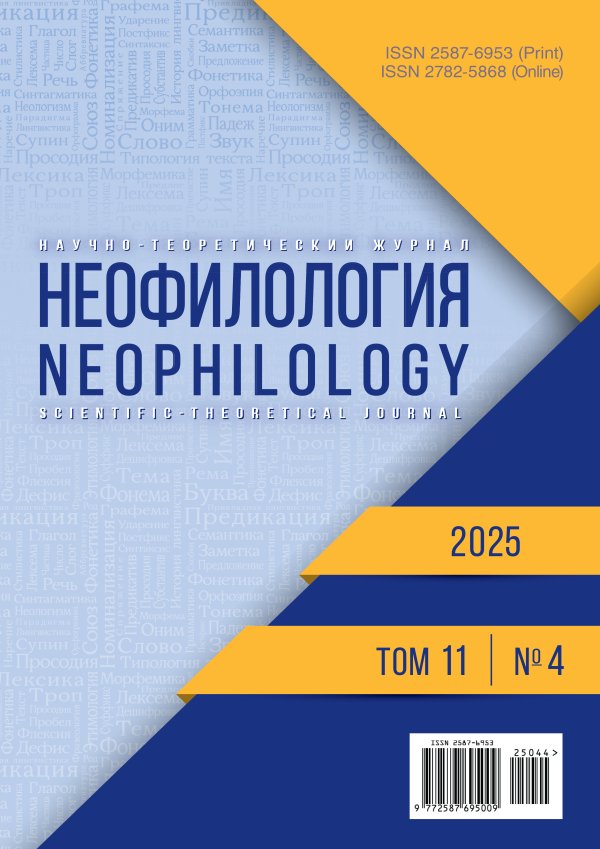
- 作者: Markov A.V.1
-
隶属关系:
- Russian State University for the Humanities
- 期: 卷 11, 编号 4 (2025)
- 页面: 942-953
- 栏目: LITERATURE MAP IN PERSONS, FACTS, EVENTS
- URL: https://bakhtiniada.ru/2587-6953/article/view/358487
- DOI: https://doi.org/10.20310/2587-6953-2025-11-4-942-953
- ID: 358487
如何引用文章
全文:

详细
INTRODUCTION. An episode from Ivan Elagin’s poem “Pamyat” (“Memory”), s examined, describing his meeting with Daniil Kharms, during which the latter equated the poetry of Alexander Blok and Vasily Lebedev-Kumach as “two sides of the same coin”. This gesture is considered not as a particular aesthetic incident but as a key moment of the collision of two cultural paradigms: tragic, mythologizing Romanticism and sober, anti-heroic Modernism.
MATERIALS AND METHODS. The empirical basis of the study consisted of Elagin’s poetic text, Kharms’s poem “Pochemu” (“Why”) in two versions (canonical and Elagin’s), texts by Blok and Lebedev-Kumach, including their translations of Horace’s odes, as well as the cultural context of the film “Vesyolye rebyata” (“Jolly Fellows”, 1934). The application of intertextual, comparative, and rhetorical analysis made it possible to identify the common features of Blok’s and Lebedev-Kumach’s poetics.
RESULTS AND DISCUSSION. The conducted analysis led to the following results: a) Kharms criticized not specific poets but the principle of “priesthood” in art common to both; b) Lebedev-Kumach acts not as an antithesis but as an heir to the Symbolist model, using its rhetorical strategies for the tasks of Socialist Realism; c) the common ground for Blok and LebedevKumach was their translation strategy, which transformed Horace’s irony into pathos-filled prophecy or didactics; d) G. Alexandrov’s film represents an intermedial experiment that counteracts avant-garde intermediality and places romance lyricism and satire within a single context of complex intermediality.
CONCLUSION. Kharms’s remark represents an accurate diagnosis of the cultural situation of the 1930s, when the priestly pathos of Symbolism became a part of the intermediality of the “grand style”. In the conversation with Elagin, Kharms’s poem turns into a manifesto proposing a paradigm shift from poetry-as-myth to poetry-as-gesture, exposing the absurd mechanics of the world.
作者简介
A. Markov
Russian State University for the Humanities
编辑信件的主要联系方式.
Email: markovius@gmail.com
Alexander V. Markov - Dr. Sci. (Philology), Associate Professor, Professor of Cinema and Contemporary Art Department, SPIN-code: 2436-2520, RSCI AuthorID: 181224, ResearcherID: Q-7934-2016. Scopus Author ID: 57215218399.6 Miusskaya Sq., Moscow, 125047 俄罗斯联邦
参考
补充文件

