






 Email this article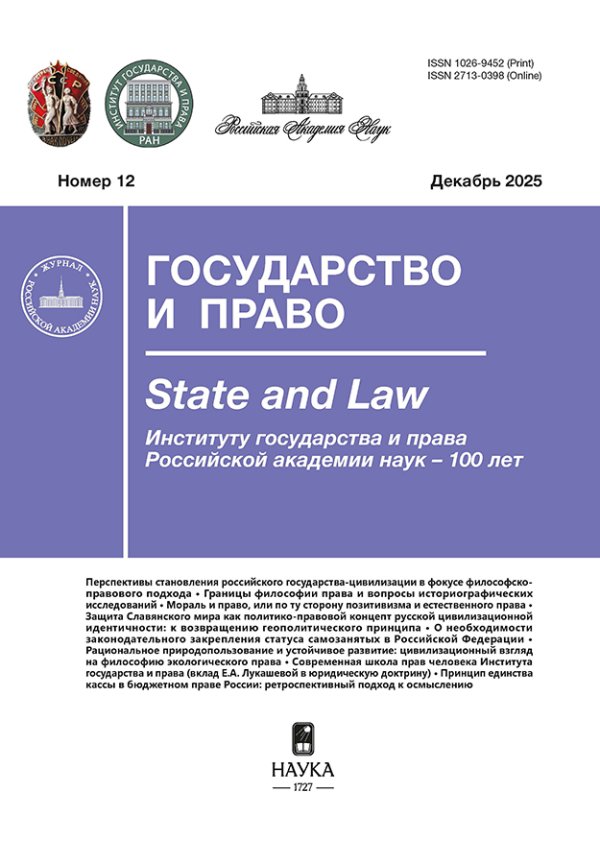
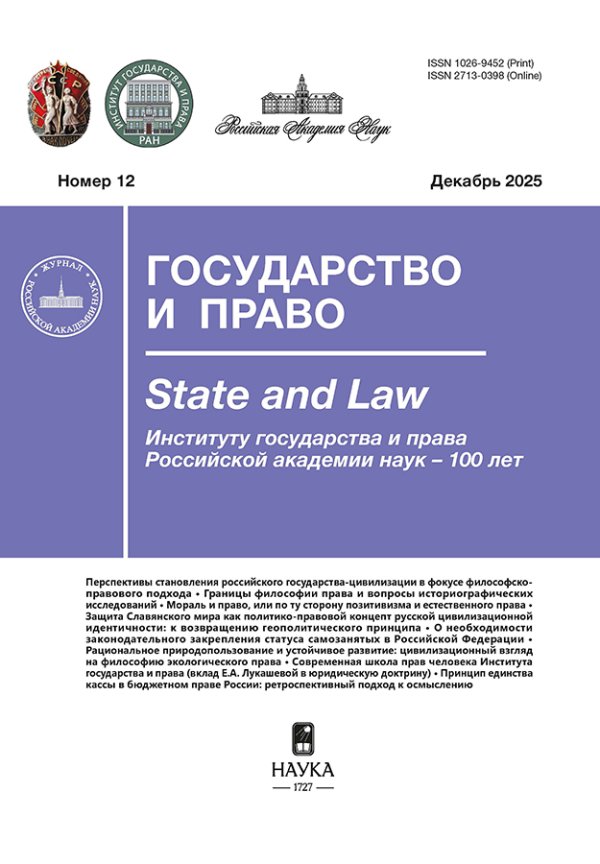
PROSPECTS FOR THE FORMATION OF A RUSSIAN STATE-CIVILIZATION IN THE FOCUS OF A PHILOSOPHICAL-LAW APPROACH
- Authors: Lapaeva V.V1
-
Affiliations:
- Institute of State and Law of the Russian Academy of Sciences
- Issue: No 12 (2025)
- Pages: 7-15
- Section: Articles
- URL: https://bakhtiniada.ru/1026-9452/article/view/355786
- DOI: https://doi.org/10.7868/S3034543X25120018
- ID: 355786
Cite item
 Open Access
 Access granted
 Subscription Access

Abstract
The scientific and practical relevance of the problem under consideration is due to the theoretical underdevelopment of the concept of “state-civilization”, as well as the need for Russia to more clearly position itself as a state-civilization in the context of global transformations associated with the transition to a multipolar world order. The author set the following goals: to give a clearer definition of the concept of “state-civilization” based on the distinction between such concepts as “civilizational identity” and “sociocultural originality”; to analyze the main problems associated with the formation of Russian civilizational identity; to outline the directions of philosophical and legal understanding of Russian civilizational specifics; to answer the question of whether Russia at this stage of its development can be considered as a state-civilization or is it still a project, the implementation of which requires the implementation of an appropriate state and legal policy. The analysis concludes that Russia, which has enormous civilizational potential, is still in the process of becoming a state-civilization. Progress in this direction is hampered by the absence of a value mainstream in the public consciousness of Russians that would express the commitment of society to a certain type of civilizational development, as well as the lack of development of a national project for the future that would be able to unite society and become (due to its universal significance) a factor of “soft power” that would attract allies beyond its borders. To solve these problems, it is necessary to have such a state policy in the field of forming the civilizational identity of Russia that, on the one hand, would be based on the spiritual and sacred sources of Russian statehood, and on the other, would be part of the strategy of Russian modernization.
About the authors
V. V Lapaeva
Institute of State and Law of the Russian Academy of Sciences
Author for correspondence.
Email: lapaeva07@mail.ru
Moscow
References
- Antomonova Yu. A. Transformation of the concept of “harmony” in the history of Confucianism // Herald of the University. 2012. No. 10. Pp. 264–267 (in Russ.).
- Asmolov K. Asian values as a road to progress. Why the Confucian cultural region made a breakthrough from the Third World. URL: https://www.globalaffairs.ru/articles/ aziatskie-czennosti-kak-doroga-k-progressu (accessed: 11.05.2023) (in Russ.).
- Auzan A. A. Cultural codes of economics. How values influence competition, democracy and the welfare of the people. M., 2022. P. 116 (in Russ.).
- Akhiezer A. S. Russia: criticism of historical experience. Socio-cultural dynamics of Russia. Novosibirsk, 1997–1998 (in Russ.).
- Gorban V. S. Why Philosophy of Law today? // Theory and practice of social development. 2018. No. 2 (in Russ.).
- Lapaeva V. V. Law in the era of the technological revolution. The progress of human genomics from the perspective of a legal approach. M., 2023. Pp. 146–150, 174–180 (in Russ.).
- Lapkin V. V. Political modernization of Russia in the context of global changes. M., 2012. P. 76 (in Russ.).
- Lubsky A. V. The state-civilization and national-civilizational identity in Russia // Humanities of the South Russia. 2015. No. 2. P. 41 (in Russ.).
- Mezhuev V. M. Russia and Europe: is dialogue possi¬ble? // Personality. Culture. Society. Iss. 1. Philosophy in the World and the world of Philosophy (on the 80th anni¬versary of the Institute of Philosophy of the Russian Acade¬my of Sciences). 2008. Pp. 96, 97 (in Russ.).
- Ostanina O. A. The problem of socio-cultural identity of Russian society in the 21st century // Proceedings of the St. Petersburg State Institute of Culture and Arts. Vol. 206. Sociology of Culture: experience and new paradigms. 2015. Part 1. P. 87 (in Russ.).
- Pantin V. I. Civilizational identity in the political dimension // Identity: personality, society, politics / ed. by I. S. Semenenko. M., 2017. P. 143 (in Russ.).
- Savenkov A. N. Philosophy of Law and the formation of the Russian state-civilization. M., 2024 (in Russ.).
- Semenenko I. S. Identity in the in the mainstream of political science and in the focus of public policy // Identity: personality, society, politics. New contours of the research field / ed. by I. S. Semenenko. M., 2023. P. 10 (in Russ.).
- Semenenko I. S. Socio-cultural modernization and identity conflict // Reforming Russia / ed. by M. K. Gorshkov. M., 2013. Iss. 12. P. 126 (in Russ.).
- Slezkin Yu. L. The original state-civilization, its neighbors and relatives // Russia in global politics. 2023. Vol. 21. No. 4. Pp. 96, 97 (in Russ.).
- Spiridonova V. I., Sokolova R. I., Shevchenko V. N. Russia as a state-civilization: philosophical and political analysis. M., 2016. P. 6 (in Russ.).
- Timoshina E. V. “The common good” of the classical legal tradition: current discourse and the fate of concepts in world paintings (Antiquity and the Middle Ages) // Questions of Philosophy. 2025. No. 4. Pp. 5–16 (in Russ.).
- Timoshina E. V. “The Common good” of the classical legal tradition: the fate of the concept in the worldview (Renaissance and early Modern times) and modern attempts to rehabilitate it // Questions of Philosophy. 2025. No. 5. P. 66 (in Russ.).
- Huntington S. Who are we? Challenges to American national identity / transl. from English by A. Bashkirov. M., 2004. P. 104 (in Russ.).
- Chicherin B. N. Philosophy of Law. M., 1900. P. 55 (in Russ.).
- Vermeule A. Common Good Constitutionalism: Recovering the Classical Legal Tradition. Polity Press, 2022.
Supplementary files
