






 Email this article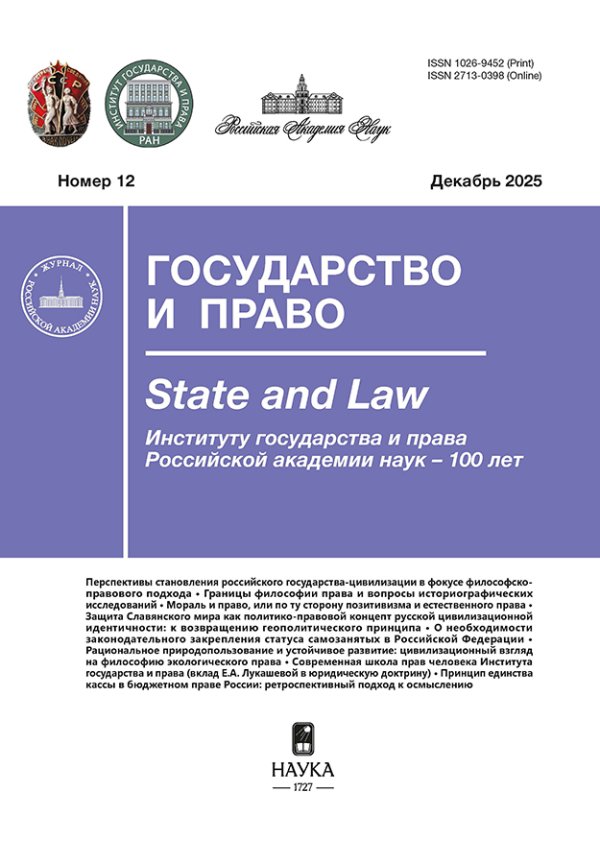
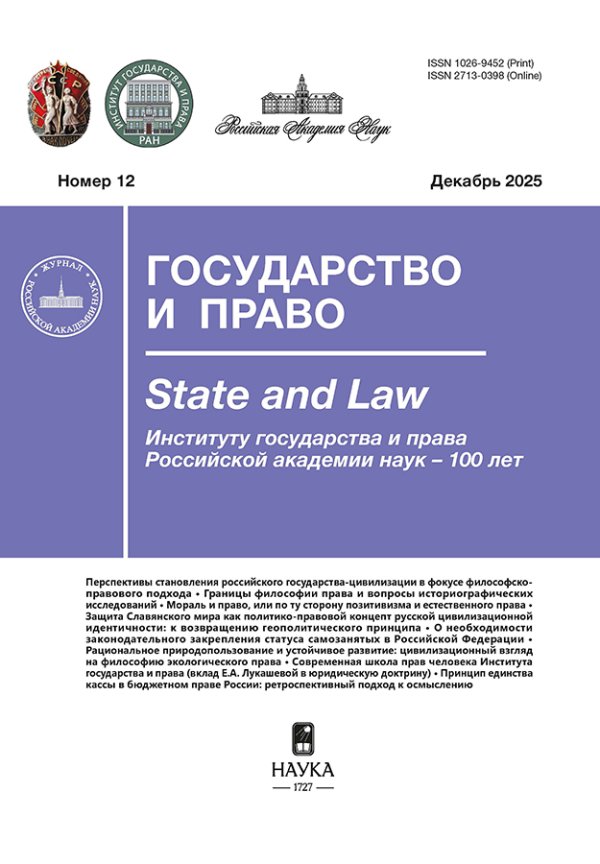
THE PRINCIPLE OF UNITY OF BUDGET ACCOUNT IN RUSSIAN BUDGETARY LAW: A RETROSPECTIVE APPROACH TO UNDERSTANDING
- Authors: Artyukhin R.E1, Kozyrin A.N2
-
Affiliations:
- The Federal Treasury
- Peoples' Friendship University of Russia named after Patrice Lumumba
- Issue: No 12 (2025)
- Pages: 184-195
- Section: Pages of history
- URL: https://bakhtiniada.ru/1026-9452/article/view/355804
- DOI: https://doi.org/10.7868/S3034543X25120193
- ID: 355804
Cite item
 Open Access
 Access granted
 Subscription Access

Abstract
The cash system is one of the most important characteristics of Financial Law. The state of public finances, the effectiveness of the budget process in general, and the execution of the budget in particular depend on the choice of the cash system. The centralization of public power and the need to improve state financial control led to the transition from a decentralized cash system to a unified cash system. In Russia, the establishment of the principle of unified cash in budgetary law was associated with the Tatarinov reforms of the 1860°. The Russian historical experience provides a normative and empirical material for understanding the principle of unity of budget account. Throughout the 19th and 20th centuries, all known models of the cash system were used in Russia: the treasury model, the banking model, and the mixed model. The development of Russian budget legislation in the 21st century creates new contours of organizational and legal forms for the cash execution of the budget. Changes in the political and economic situation in the country, as well as improvements in information and communication technologies, are leading to the emergence of new institutions in the field of Budgetary Law. The creation of the treasury payment system in the early 2020s led to the unification of treasury and banking functions within the Russian Treasury, thereby overcoming the antagonism between the banking and treasury models of the state's cash system.
About the authors
R. E Artyukhin
The Federal Treasury
Author for correspondence.
Email: budgetlaw@mail.ru
Moscow
A. N Kozyrin
Peoples' Friendship University of Russia named after Patrice Lumumba
Email: kozyrine@mail.ru
Moscow
References
- Aleksandrov A. M. Finance of the USSR / ed. by N. N. Rovinsky. M., 1952. Pp. 431–433 (in Russ.).
- Artyukhin R. E. The cash register and the budgetary and legal principle of the unity of the cash register // Laws of Russia: experience, analysis, practice. 2022. No. 8. Pp. 95– 101 (in Russ.).
- Zagryatskov M. D. Budgetary rights of local councils. M., 1924. P. 12 (in Russ.).
- Lebedev V. A. Financial Law. 2nd ed., reprint. St. Petersburg, 1890. Vol. 1. Iss. 2. Pp. 385, 427 (in Russ.).
- Ozerov I. H. Financial Law: lecture notes. The budget, forms of collection and local finances. M., 1902. P. 202 (in Russ.).
- Speransky M. M. Plan of finance // Golden pages of financial law of Russia. Vol. 1: At the origins of Financial Law. M. M. Speransky, N. I. Turgenev, M. F. Orlov. M., 1998. Pp. 92, 94, 95 (in Russ.).
- Tarasov I. T. Essay on the science of Financial Law. Yaroslavl, 1883. Pp. 387, 388 (in Russ.).
- Tatarinov V. A. State reporting in Austria. St. Petersburg, 1858 (in Russ.).
- Tatarinov V. A. State reporting in Belgium. St. Petersburg, 1858 (in Russ.).
- Tatarinov V. A. State reporting in Prussia. St. Petersburg, 1858 (in Russ.).
- Tatarinov V. A. State reporting in France. St. Petersburg, 1858 (in Russ.).
- Tatarinov V. A. Reporting of the Naval Department in France. St. Petersburg, 1858 (in Russ.).
- Tatarinov V. A. Economy and reporting of the Ministry of War in France. St. Petersburg, 1858 (in Russ.).
- Fedyaevsky K. K. Budget execution in capitalist countries / ed. and with a preface by M. I. Bogolepov. M., 1939. Pp. 115, 116 (in Russ.).
- Fedyaevsky K. K. Cash register and cash register device. M., 1928. Pp. 11, 12 (in Russ.).
- Financial and credit dictionary / ed. by V. F. Garbuzov. M., 1986. Vol. II. P. 26 (in Russ.).
- Shovskiy A. A. The unity of cash registers and the budget of gubkom farms. M., 1925. P. 1 (in Russ.).
- Yalbulganov A. A. The State Controller V. A. Tatarinov and the reform of financial control in Russia (1850– 1860s) // Fi¬nance. 2000. No. 1. Pp. 69–71 (in Russ.).
- Yalbulganov A. A. State control in the era of M. M. Sper¬ansky: rise and fall // Presidential control. 1998. No. 1 (in Russ.).
- Yalbulganov A. A. The origin of state control in Russia in the second half of the XVII–XVIII centuries (historical and legal research) // State and Law. 2001. No. 10. Pp. 89–97 (in Russ.).
Supplementary files
